Sunday, May 20, 2012

The Interlude Continues

Boy howdy, if I haven't received loads of encouragement! As I stated in my last entry, I've had to take some time away from writing blog entries so I could wrap up a few major projects. Since that post, I've received tons of emails wishing me luck, and others saying "I hope you will return to writing when you finish!" So, a gigantic thank you to everyone who wished me well in my time away from Under the Microscope.

Yet, my time apart is not completely over. I'm currently in San Diego for a collaborative work project with The J. Craig Venture Institute, and when I return to the Bay Area, I will be quickly hopping on a plan for a few weeks for a much needed vacation. I will try to write in the meantime, but promises are always futile.

...

I drove to San Diego instead of flying, partially because I wanted to bring my bike with me, and partially because I wanted some time alone to think. I spent a lot of time listening to old podcasts from Radiolab, which got me thinking about future blog posts. Trying to decide what to write about next is troubling for me, believe it or not. Writing is not a natural habit for your truly, unless its in a lab notebook. I can remember all of my major writing accomplishments throughout my personal history, as they were few and far between. In the seventh grade, I chose to write my literary research paper on the bubonic plague, narrated by the only unaffected living thing in the town: a tree. Oh, twelve-year-old me, you were so dark, so profound! I had clearly been listening to too many records by The Cure. The next was my Advanced English research paper that I chose to do on Bram Stoker, and other historical works which focused on vampires. If I would have known, at age sixteen that Twilight would be a thing in future times, well, I would have been a rich little idiot.

Anyway, I struggle with deciding on future topics for Under the Microscope. There are too many species, too many diseases, too many, too many, too many! But listening to one old Radiolab podcast in particular reminded me of why I write. I highly suggest you dedicate an hour to listening to this show, titled Parasites, from 2009.


Carl Zimmer has always been a role model of mine (ok, I'll admit it, I have a crush), as he often takes the side of the parasite. Not only is this rare, but it's exactly the standpoint that I've always taken. Think about it: humans are, without a doubt, the most advanced life form of which we know, yet we can easily be challenged and occasionally defeated by "lesser" life forms. Parasites, some of which are even single celled organisms, bacteria, and viruses, which aren't even considered to be "alive"! Sure, we've evolved and developed habits and methods to limit our exposure and risk of such encounters, but they don't always work.

This show about parasites always makes me laugh when I listen to it because people always ask me if I've ever heard of Jasper Lawrence, or "that guy that sells worms". I never really know how to react, because I do applaud Mr. Lawrence for taking his medical care into his own hands (or should I say gut?) and I am totally happy that shows like Radiolab have made that sort of science accessible to everyone... but starting your own business off of it is a little sketchy. Mr. Lawrence keeps a blog associated with his business, wherein he describes his family life and his allergies. There is one entry where he discusses the risks associated with obtaining hookworms in the wild (ie, naturally), but it's basically just a review of wikipedia pages.

So, maybe I should talk about hookworms? I've written previous entries on tapeworms and other types of parasitic nematodes, but I can't recall an entry that specifically focused on hookworms.

Ascariasis and infections by Ancylostoma duodenale and Necator americanus are pretty harmless, and while uncommon in the United States, it is highly prevalent in other regions of the world. You often find prevalent hookworms in areas where modern plumbing is unavailable, and human feces is used in fertilizers. Poop everywhere!


The filariform larvae of A. duodenale and N. americanus cause infection by burrowing into the skin, typically around the feet or ankles when exposed in shallow waters or muddy areas where infected feces is present. In instances where feces is used for fertilizer, Ascaris eggs can be ingested with fruits and vegetables that are not thoroughly washed.


Once in the body, the adults attach to the lining of the small intestine and feed on blood and protein sources. There are very few symptoms associated with a hookworm infection, and many people are unaware of infections that they've had for years! If an infection is particularly heavy, the individual can experience anemia and protein deficiency.

What's amazing about these creatures is that they've phenotypically adapted to their ideal environments. They may be blind and deaf, but there are many different types of hooks and "teeth" that allow them to anchor themselves to one tissue surface for years. I've always imagined the following nerd references when studying hookworms and tapeworms, but what can I say, I'm totally unprofessional.

Credit: Dan Meth

In the real world (sighhhhh), hookworm "mouths" usually have one row of teeth, like this:

This photo is entirely not scary if you imagine it's singing opera.

I should say that I've always approved of the Hygiene Hypothesis, as I was raised in an area where many people suffer from seasonal allergies, and I do not! Maybe I'm just biologicaly supreme, or maybe it's because I did have my own run-ins with a few parasites at young ages. Either way, this theory is commonly centered around the ability of your system to produce a specific types of antibodies (IgE) that are associated with allergic reactions and helminth diseases (parasitic worms).

While that is all I have time for today, I want to end by saying, once again, that I will update as much as possible. Also, I'd like to send out magical vibes to Carl Zimmer, in hopes that he might agree to have lunch or dinner (or tea!) with me when he is in San Francisco in October. Maybe?

Thursday, April 5, 2012

Microscopic Intermission

I've been receiving quiet a few emails lately asking if I'm going to continue writing or if I've died in the lab. Thanks for the concern! My answers are yes and no, respectively.

I'm in the process of wrapping up two giant research projects, and scrambling to get the papers together for maybe a publication or two (OH PLEASE LET IT HAPPEN). So, I hope you'll excuse my brief blogging absence while I spend every waking moment dedicated to these projects. I wanted to find a way to display my anguish on this blog when a fellow colleague of mine sent this to me. I thought it was so hilarious that I laughed a great big laugh. This laugh was so great, that the other people around me were temporarily convinced that I had finally snapped and my proverbial marbles were spewing all over the floor.

Credit goes to Electron Cafe:

I'm currently at the OH HEY, THIS MAKES SENSE phase. 

In other news, I walked around looking as if I had peed my pants yesterday due to an unfortunate altercation with the ice machine. I'll be back before you know it.

Tuesday, February 7, 2012

Hearts A'flutter with Infection

I admit, I'm a total sucker for Valentine's Day. I'm pretty sure this has something to do with my childhood, since my mother's favorite holiday is Valentine's Day. She made it her mission to make Valentine's Day as big as Easter, right down to getting festive baskets full of heart-shaped candies and whatnot.

What I also love about it is the imagery. It's the one day of the year when mainstream culture romantically fetishizes an internal organ! How sexy is that?


Did you know that in one day, the force of your heart pumping causes your blood to travel approximately 12,000 miles? That's four times the distance across the United States, from one coast to the other.

The heart is an amazing organ. It's, quite literally, the lifeblood of your existence, pumping nutrients and oxygen to every bit of your body, working with the lymphatic system to circulate immune system cells, keeping you alert. But the heart is also a vulnerable place. Although we mostly hear about parasites of the GI tract, there are many other organisms that see our circulatory system as an all-you-can-eat buffet.

If you think about it, the circulatory system and heart provide the perfect environment: tons of nutrients (see: snacks), tons of oxygen, a comfortable temperature (like a sauna full of blood) and hardly any competition.Who wouldn't like that?

Since this is a post for Valentine's Day, I'd like to tell you about the best of the best. Please keep in mind that there are thousands of things that can find their way to your heart and eat you inside out. These are just some of the highlights.

Protozoan parasites:
Leishmaniasis is typically seen to affect the spleen, liver and bone marrow during a visceral infection (as opposed to the cutaneous infection that causes lesions and boils), but it can also find it's way to your heart and cause damage there. There are about 500,000 new cases of visceral leishmaniasis every year, but they are all dependent on the local sand fly population, which acts as the vector for the disease.


Visceral leishmaniasis results in the inflammation of the infected organs. If not treated, the swollen organs may become non-functioning, which can result in organ failure and death.


T. cruzi, the cause of Chagas Disease, has shown high cardiotropism that is unmatched by other parasitic organisms. This flaggelated protozoa has the ability to "swim" or move throughout your system.

Not a sea slug, but just as cute?
Once settled in a comfortable area (filling the void of your broken heart), your heart will begin to swell with the inflammatory response. After trying to kill off the invading organisms, cellular damage and fibrosis occurs, making the likelihood of heart failure very high.

This is your heart on Chagas Disease.


Worms and things:
Schistosomiasis, also known as Snail Fever, is a parasitic worm that causes a chronic condition in adults, and impairs cognitive development in children. Early stages of Schistosoma development, the immature worm feeds on red blood cells. While it mostly affects the liver, the worms occasionally can get turned around and burrow into the heart tissue. Schistosomiasis has a very low mortality rate, but is very devastating. 

D. immitis is the very well known "Heartworm". We mostly hear about heartworms in our pets, but they can definitely infest humans, albeit rarely. The heartworm doesn't become an adult until it has settled into the pulmonary artery. Before that, it's transmitted from host to host by it's vector, the mosquito.

Dog heart.

Echinococcosis happens to be one of my most favorite parasites. Echinococcosis infects mostly mammals, including humans, and is transmitted directly through the accidental consumption of a cyst or egg form. While mostly found in the liver, up to 25% of cases are found in organs like the heart, brain, kidneys and less commonly, lungs. But this worm is special. Echinococcosis is also known as hydatid disease, from the formation of hydatid cysts.

Hydatid cyst, single and ready to mingle.

The worm develops it's eggs into a collection of "egg sacs" or bubbles within a tissue. These sacs have multiple compartments of eggs, and have the ability to grow very large and very numerous. They are strong enough to survive the host's environment, but delicate enough to be very tricky to remove during surgery. If a cyst bursts, the patient can go into anaphylactic shock (similar to an appendix bursting).


On a sappy note, I started this blog almost 2 years ago because I needed an outlet. I was talking too much about the dangers of the world. My friends and family were tired of hearing about my research or the latest in disgusting discoveries (and still, my dad seems to be the biggest fan of my blog!). Even worse, I was ruining dates! You can always tell how the rest of the date is going to go when you mention that you may have been handling active HIV earlier that day in your lab, or you have volunteered your time to look at poop samples from the county. My favorite was the date that said, "I mean, I like nerdy girls, but I kinda just meant girls in glasses."

As of now, I'm miles ahead of where I was 2 years ago, both in my career and my life in general. To be honest, I never really thought that my life would involve any sort of writing, other than the to-the-point articles of my great discoveries in science (I say, as if I'm Marie Curie or Barbara McClintock). What I'm trying to get at with this uninteresting rant is THANK YOU, dear readers, for taking an interest in my low-bar jokes and nasty photos. I hope this blog has, and will continue to, help you as much as it has helped me.

Happy Valentine's Day!

Saturday, January 14, 2012

Common scientific myths that are regularly exploited by mass media

I'm a gmail user, and I have my iGoogle news widget set to show me all the "health" related news (if you've seen this setting, then you understand why I use parentheses with the word health). There is always at least one laughable article each day. While this is funny, it's also really scary.

I mean, around the time of the listeria outbreak in cantaloupe, there were 1,600 articles a day that clearly stated "OMG DON'T EVER EAT CANTALOUPE EVER AGAIN!" Was that necessarily helpful? Is that considered informed reporting? Not everyone wants to read scientific articles for accurate information. I mean, I don't even want to read them (that was a lie). Scientific writing is different. It's blunt and bland, lacking any decoration. But, it's also very important.

So, on Friday, I sat down at my desk at work and opened up my browser to see a particular article that lit a fire under my butt faster than a bunsen burner attached to a leaky gas valve (insert fart joke here). Everything about it was wrong, and it scared me! So, I decided to round up a few myths about recently popular science topics.

Myth #1: Just about everything you've ever heard about HIV or AIDS from mainstream media.
If you know anything about me, you'll know that this is my biggest pet peeve (well, that and chewing with your mouth open, but I digress). Since the beginning of the HIV/AIDS epidemic in the 1980s, mainstream media has disregarded scientific progress and facts when reporting on the matter. We've heard everything from "AIDS is a gay disease" to "the government created HIV to scare the American public into submission", and every idiot thing you can think of to fit in between. My favorite is "HIV isn't real".

...oh, right. Why don't you tell that to the 43,000 people, in the United States alone, that were diagnosed with new HIV infections in 2009.

The article that actually inspired this blog entry ['HIV was invented as the cause of AIDS to get research money' claims radio host] can pretty much be summed up in this video. Need I comment on this?

Last year, news of a research breakthrough exploded all over the world. "Finally! Scientists have cured a man of AIDS!" It was everywhere, but it's not exactly...oh, what's the word I'm searching for...reasonable? Yeah, that's it! Bone marrow transplants are difficult and expensive. You must have a very specifically matched donor to avoid any complications (ie- rejections or immune responses to the foreign matter).

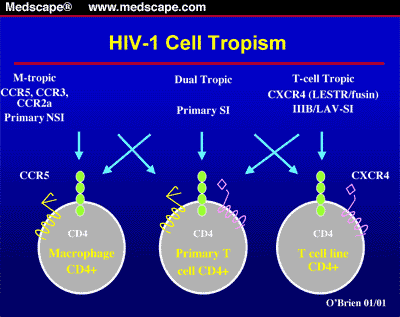
The concept behind the bone marrow transplant was based on the delta32 mutation. Discovered in 2005, the delta32 mutation allows a fraction of the population of Europe to show signs of immunity towards HIV-1 infection, but not all types of HIV-1 infection. Viral tropism allows for different strains, or variants, of the virus to use different co-receptors that are naturally expressed on the host's cells, primarily T-cells. CCR5 and CXCR4 are the two co-receptors that are primarily used for access to the host cell. These co-receptors are also used to elicit a cell-mediated immune response. Due to viral tropism, different strains utilize different co-receptors for viral entry into the host cell. That is, HIV-1 strains that use CXCR4 don't necessarily need CCR5 co-receptors for entry. Therefore, individuals who have the delta32 mutation are not 100% immune.


People are all too quick to jump on the opportunity to say "We've done it! We've cured AIDS!" We saw this in the dawn of medicinal cocktails, and we'll see it again. But, the magnitude of this disease is so great, that the types of breakthroughs we are making right now are not satisfactory enough. We cannot feasibly give every HIV-positive person a bone marrow transplant, but we can turn to the micro-science behind the theory of why this works. We can't look at HIV medication, because they are expensive, extensive and not available to everyone, but we can look at making more affordable and readily available drugs. It's one thing to be blanketly hopeful; it's another to be realistic.

Myth #2: Food poisoning is limited to meat products.
This is an easy one. The probability of getting a food-borne illness does increased when livestock involved (POOP, EVERYWHERE!), but also has to do with the fact that most people don't effectively cook their meat. Let's face it, there is poop covering everything on this planet, whether it's from humans, animals, or insects. That is why we have immune systems.

This is something I hear a lot from people, because I'm vegan. "Have you read Fast Food Nation? Did it scare you into your dietary choices?" Just stop it. It's not about any book or any food-borne pathogen. We've gotten to the point to where our food is so mass-produced and unproportionally regulated that we are bound to run into problems, no matter what we choose to put in our mouths.

Interestingly enough, wikipedia has a very extensive list of food-borne illnesses, listed chronologically by year. Some of the deadliest, actually have been in cantaloupe, peanuts, spinach, bean sprouts, green onions and apple juice. By all means, take this into account, but don't let it scare you away from the ever important "green group" on the food pyramid (or plate, or whatever you want to go by).  Take actions into your own hands, and look at where you are getting your food from, and how you are preparing it. I've already written about the horrors of food (and feel free to refresh your memory!), and I'll probably do it again.


Myth #3: Immunizations will give your child autism.
Oh, Jenny McCarthy, you gorgeous idiot. I thought this issue was left behind with the early 2000's, but apparently I was wrong.

According to facebook, everyone I know is pregnant right now, and everyone is posting about issues like "is breastfeeding wrong?" or "does Baby Einstein really work?" Sure, whatever. I'm all for people trying to decide what is best for their child, and using whatever resources are available to them to do so. But, one of my friends started posting videos (this one in particular) about the horrors of vaccines, and stated that she was trying to decide what to do for her newborn (while logically consulting youtube).


Instead, why don't you start with the CDC's take on Vaccines and Autism. A scientific review by the Institute of Medicine (IOM) concluded that "the evidence favors rejection of a causal relationship between thimerosal-containing vaccines an autism." The CDC supports the IOM conclusion. Also, here is an article from 2007, titled Vaccines and Autism, by Dr. Brown, that talks about immunizations from a medical perspective. Both the medical and scientific communities reject Jenny McCarthy's claims that vaccines cause autism.

Nevermind that the first vaccination demonstration in 1798 would lead to the eradication of smallpox in 1980. Or more recently, nevermind the fact that polio has almost been eradicated in India due to vaccinations. Oh, I get it, you're worried about what vaccines will put in your child's body, but you'll feed them McDonalds. That makes sense.

I understand they hysteria of wanting to do what's best for your child, but I will never understand taking medical advice from a model (oh wait...she was "Playmate of the Year" in the 90's, so that's like getting a doctorate, right?), or from youtube.

Let's talk about health the health of children around the world.


There are plenty of other myths out there that I'd be happy to discuss. Just send me an email with your requests.

Also, my belated apology for not writing more frequently. I've been working very hard lately to get two grants, and things are starting to pay off (literally and figuratively!). 

Monday, October 31, 2011

Ghosts, Goblins & Things That Will Actually Kill You

I love Halloween, which is why I'm sitting at home alone, wearing my festive ghost-print pajama pants, tea in hand, writing this blog entry. As I sit here, eating my unfestive leftovers and unexciting salad, I'm laughing to myself. NPR is posting ghost stories, Buzzfeed posted "10 creepy photos from Halloweens Past", and articles like "13 Real Animals Lifted Directly Out of Your Nightmares" [cracked.com] are actively being read.

So, I'm giggling to myself, pushing my food around in the bowl thinking, "how can I write a blog entry about things that are already halloween-esque?" This is a challenge for me, because I am not a fan of horror films. I know, you'd think someone who dedicates their life to viruses, parasites, and other creepy crawlies would be excited by the thought of paying $12 to go watch two hours of ghouls and scantily-clad ladies screaming... but I'm not.

Then I found this list of the 10 Scariest Horror Movie Characters (also on Buzzfeed, which is oddly addicting if you avoid all the celebrity gossip and pseudo health advice). While I have only seen one of these movies, I think I can match all of these horror movie characters with real horror. So here we go...

1. Exorcist Girl? Ebola


Sure, I haven't seen this movie, but I can recognize all the references from pea soup to spinning heads. There are parasites that take over their hosts' brain functions, but that's mostly seen in smaller animal models or with prion diseases (which are not parasites). Want to read about Ebola? Check out one of my past entry here.


2. Leatherface?  Leprosy.


 Leprosy is a really unfortunate infection that is fortunately curable when discovered early. Read up on it here.


3. Creepy Girl from Quarantine?  Hookworms.


Nothing says sexy like gnashing teeth.


4. Jason Vorheese?  Primary Amoebic Meningoencephalitis


Both Jason and Primary Amoebic Meningoencephalitis are found lurking in lakes and pools of water, and both will make you crazy. 


5. Old Man from The Unborn? Hobo Spiders.

My partner called my attention to these baby hand-sized wonders. Apparently, he used to wake up to them crawling on his chest, and the males also are very territorial and will charge at you and chase you around a room.


6. Pennywise from It the Clown? Tapeworm.


Both Pennywise the Clown and tapeworms lives amongst poop and eat your insides. The similarities are uncanny! Read about fun tapeworms here!


7. Freddy Kruger?  Bedbugs.


 ...because they get you in your sleep! Here's an older post about bedbugs that will make you want to sleep with one eye open.


8. The Girl from the Ring? Onchocerciasis.


 Onchocerciasis is the clinical term for "River Blindness", which is a disease caused by an infectious roundworm. This one is a bit of a stretch, I know, but that girl has creepy eyes.


9. Michael Meyers?  MRSA.

One of the latest things in medical news is drug resistance. Much like Michael Meyers, MRSA just wont die!


10. Old lady from Legion? 


Three Words: Ellen Albertini Dow


Happy Halloween!

Tuesday, October 4, 2011

The Plague of Inaccurate Articles

I have to admit, I am partially in love and partially disgusted with the internet. On one hand, it's rad to have answers to almost any question right at your fingertips at any moment in time. But how do you know that those answers are correct? Half of the time I spend reading articles, I find myself thinking "who wrote this stuff anyway?"

Everyone I know is constantly worried about where to get the most accurate source of news about politics, social justice issues, business matters, etc., and I commend them for that. But I also want you to know that such an idea completely pertains to science as well.

I'd like to provide you with an example based on an article that was published this evening by NPR. Ok, I admit, I'm an avid listener to NPR, and I follow them on twitter so I don't have to sort through all the repetitive and mundane articles that come up on google news. But sometimes they are wrong. Sometimes they are horribly wrong.

The article is called "Surprise in Your Sewage: Lots of Exotic Viruses", by Richard Knox. According to NPR's bio page, Richard Knox is totally adorable and has a wicked mustache. After reading the article in question, you'll also notice that he ironically won awards in 1995 for articles covering medical errors. Let's talk about your scientific errors, Richard.

The article starts out on an accurate note. Richard bluntly states that, well, being a scientist is harder than any job you've ever had. As someone who has worked a number of strange jobs (autopsy review assistant, event planner, health educator on a college campus, checker at whole foods,  bra slinger at victoria's secret... yea, I was 18, get over it), the time I've spent looking at human poop under a microscope, literally spending 24 hours straight in lab, or falling asleep while reading scientific paper after scientific paper only to wake up with highlighter ink all over my face has been truly hard. I think back to all the dangerous and toxic chemicals I've had to pour into tiny tubes, all the calculations that I had to check 6 times to make sure I didn't accidentally cause an explosion, or all the tubes of moisturizer I've had to purchase for my rough, over-ethanol'd hands, and I know that I love being a scientist.

After that distinction, the article falls apart quickly.

Fault #1: Inaccurate terms coined for viruses.
This is one of my biggest pet-peeves. It's one thing to convert scientific research articles into layman's news articles, but don't use words like "bugs" or "germs". It's wrong.

Richard doesn't stop there, though. He brings in the famous "microbes" term, which is invalid for this article to begin with. Sure, "microbe" is short for microorganism, meaning an organism that is of microscopic size, but it's a term that's typically reserved for bacteria.

 Also, the term "microbe" suggests that the organism is living, whether single-celled or otherwise. No one has determined whether viruses are "living". To say so, one way or another, is inaccurate.


Fault #2: Know your diseases, buddy.

Firstly, what is a "monkey microbe"? Is it a bacterium with a prehensile tail? There is something disturbing about the insinuated phylogeny of that term.

Anyway, Ebola is one of my favorite viruses. I love it. It's deadly and gross, and the amount of information known about it is relatively minimal. So minimal, in fact, that scientists have yet to identify the model system for it. There has been a lot of research done to try to identify monkeys as the model system, yet they have been unsuccessful. While the disease is seen in monkeys, its not necessarily the origin. Another target species is bats. So, to say that Ebola is a "monkey microbe" is wrong.


Once again, I understand the need to dilute such scientific language, but challenge your readers. Say its a "zoonotic virus" instead of "that jumps to humans when given the opportunity". I mean, come on. This isn't FOX news, now.


I have a hard time crediting articles that make such basic mistakes. I'm glad that Richard links to credible websites for further information, but we know that most people are going to stick to whatever is on the page right in front of them.

If you follow me on twitter, you may remember reading about a similar issue I had with an article for DemocracyNOW! that said that someone had been "cured of AIDS". This is wrong, and it just goes to show that the little details can have profound effects on the rest of your article's efficacy.

Want to get accurate information about science news? Here are some sites that I highly recommend:
ScienceDaily
Science News
PubMed


Thursday, September 29, 2011

I'd love to marry you right now but I cantaloupe, because I just shit myself

Ah, word play. My partner and I laughed for a good hour last night about possible listeria-themed titles for my next blog update. You should have been there, it was pun-tastic.

So, I have to admit, I have been avoiding writing a new update because I just couldn't choose a topic to write about. There is so much going on right now in terms of fun diseases and outbreaks, and I don't want anybody to feel left out.

...which is why I've decided to do a quick round-up!


Listeria monocytogenes - Listeriosis
I feel like I'm the only one that actually cares about this. I've caught my parents eating cantaloupe on multiple occasions since the major listeria outbreaks hit the news. Maybe I just like to play it safe? Maybe I don't really like cantaloupe all that much to begin with? Maybe my parents are risk takers?

Either way, if you haven't heard by now, one of the "most dangerous" food-borne illness outbreaks is happening RIGHT NOW. Colorado-grown cantaloupes that were shipped to 25 states and various international countries are contaminated with Listeria monocytogenes, a very deadly, gram positive bacteria. Last year, there was a Listeria monocytogenes outbreak in celery.

You might be thinking, "why is this so dangerous? We hear about food-borne illness outbreaks all the time", but this is an interesting microbe with an interesting motive. Not only is this the first case of Listeria monocytogenes in cantaloupe that we've ever seen, but there have been almost 80 infection cases reported, and 13 people have died since the initial reports of the outbreak.

This is awesome! Original posting by Katalini here.

According to the CDC, Listeriosis can take up to one week to 2 months before you start showing signs of infection after being exposed to the bacteria. It could be in you right now! Funnnn! What's even more fun is that Listeria monocytogenes can continue to flourish in cold environments, meaning storing your cantaloupe in the fridge will not stop colonies from expanding.


Listeriosis has very diverse symptoms and can depend on how advanced your infection actually is. It can present itself as an upset stomach, fever, vomiting, diarrhea, headaches, dizziness, loss of balance, sore neck and muscles, convulsions, miscarriage, stillbirth and death.

If you think you may have Listeriosis, contact your local clinic or medical provider and request a test. The earlier the diagnosis, the better. Listeria monocytogenes is responsive to antibiotic treatment.

UPDATE: Listeria monocytogenes has just been traced to lettuce as well.


Two Heads are Better than One
Also, this happened:


I know the woman is saying "Frank AND Louie", but I really like the idea of her naming the cat "Frankenlouie".


Science Justifies Your Vices, Sometimes
Some idiot scientist decided to test the effects of caffeine and coffee consumption on women's moods and magically discovered that consuming 4 or more cups a day will improve your mood.

...I'm sorry, what? This is news?

Let's just get something straight before we jump into this. Caffeine is a stimulant drug. Yes, you heard me. While sometimes it is naturally produced, it can also be synthetically produced. Caffeine affects your central nervous system. Additionally, it takes about 12 hours for caffeine to completely leave your system. If you're drinking 4 or more cups of coffee a day, I can almost guarantee that your brain wont have a moment to rest.

Just think about it.


RIG-1 Protein Identified to Fight Viral Infections
RIG-1 is a cytoplasmic pathogen recognition receptor that identifies viral RNA from cellular RNA, which is a huge breakthrough for possible drug treatments for viral infections, such as Hepatitis C, Measles, Rabies, West Nile Virus and Influenza. Researchers discovered that some viral RNA is typically double-stranded, whereas cellular (or self) RNA is single stranded.


Hollywood Exploits Nationwide Paranoia: Contagion

For weeks, everyone has been telling me that they think of me when they see ads for "Contagion". I kept thinking it was a new public health effort to reduce cold and flu cases this year through early education. Silly me!


There are some big names in this feature! Unfortunately, I think I'm the only person on the face of the planet that would actually enjoy seeing this. So, I'm going to take myself on a date. "One ticket for Contagion, please! ...yes, it's only me. Yes, I'm lonely."

EDIT: Listen to an interview with the real virologist who consulted on the film! 

I've decided to review this movie. If you've seen it already, feel free to email me with your comments!