Showing posts with label publications. Show all posts

Tuesday, October 4, 2011

The Plague of Inaccurate Articles

I have to admit, I am partially in love and partially disgusted with the internet. On one hand, it's rad to have answers to almost any question right at your fingertips at any moment in time. But how do you know that those answers are correct? Half of the time I spend reading articles, I find myself thinking "who wrote this stuff anyway?"

Everyone I know is constantly worried about where to get the most accurate source of news about politics, social justice issues, business matters, etc., and I commend them for that. But I also want you to know that such an idea completely pertains to science as well.

I'd like to provide you with an example based on an article that was published this evening by NPR. Ok, I admit, I'm an avid listener to NPR, and I follow them on twitter so I don't have to sort through all the repetitive and mundane articles that come up on google news. But sometimes they are wrong. Sometimes they are horribly wrong.

The article is called "Surprise in Your Sewage: Lots of Exotic Viruses", by Richard Knox. According to NPR's bio page, Richard Knox is totally adorable and has a wicked mustache. After reading the article in question, you'll also notice that he ironically won awards in 1995 for articles covering medical errors. Let's talk about your scientific errors, Richard.

The article starts out on an accurate note. Richard bluntly states that, well, being a scientist is harder than any job you've ever had. As someone who has worked a number of strange jobs (autopsy review assistant, event planner, health educator on a college campus, checker at whole foods,  bra slinger at victoria's secret... yea, I was 18, get over it), the time I've spent looking at human poop under a microscope, literally spending 24 hours straight in lab, or falling asleep while reading scientific paper after scientific paper only to wake up with highlighter ink all over my face has been truly hard. I think back to all the dangerous and toxic chemicals I've had to pour into tiny tubes, all the calculations that I had to check 6 times to make sure I didn't accidentally cause an explosion, or all the tubes of moisturizer I've had to purchase for my rough, over-ethanol'd hands, and I know that I love being a scientist.

After that distinction, the article falls apart quickly.

Fault #1: Inaccurate terms coined for viruses.
This is one of my biggest pet-peeves. It's one thing to convert scientific research articles into layman's news articles, but don't use words like "bugs" or "germs". It's wrong.

Richard doesn't stop there, though. He brings in the famous "microbes" term, which is invalid for this article to begin with. Sure, "microbe" is short for microorganism, meaning an organism that is of microscopic size, but it's a term that's typically reserved for bacteria.

 Also, the term "microbe" suggests that the organism is living, whether single-celled or otherwise. No one has determined whether viruses are "living". To say so, one way or another, is inaccurate.


Fault #2: Know your diseases, buddy.

Firstly, what is a "monkey microbe"? Is it a bacterium with a prehensile tail? There is something disturbing about the insinuated phylogeny of that term.

Anyway, Ebola is one of my favorite viruses. I love it. It's deadly and gross, and the amount of information known about it is relatively minimal. So minimal, in fact, that scientists have yet to identify the model system for it. There has been a lot of research done to try to identify monkeys as the model system, yet they have been unsuccessful. While the disease is seen in monkeys, its not necessarily the origin. Another target species is bats. So, to say that Ebola is a "monkey microbe" is wrong.


Once again, I understand the need to dilute such scientific language, but challenge your readers. Say its a "zoonotic virus" instead of "that jumps to humans when given the opportunity". I mean, come on. This isn't FOX news, now.


I have a hard time crediting articles that make such basic mistakes. I'm glad that Richard links to credible websites for further information, but we know that most people are going to stick to whatever is on the page right in front of them.

If you follow me on twitter, you may remember reading about a similar issue I had with an article for DemocracyNOW! that said that someone had been "cured of AIDS". This is wrong, and it just goes to show that the little details can have profound effects on the rest of your article's efficacy.

Want to get accurate information about science news? Here are some sites that I highly recommend:
ScienceDaily
Science News
PubMed


Saturday, January 1, 2011

A New Year for you, and for Science

Happy New Year to all my dedicated readers, albeit the few and far between!

New Year's is always a time that I take to reflect on the past year, and search for room for improvement for the next year. A closing of one door, and a window of opportunity for the up and coming. Sure, this sounds wonderfully personal, but it can be applied to anything. I'm sure you can guess that I do take a moment (or many!) to reflect on the scientific advances for the past year. There have been some amazing discoveries that, by reflecting on them, can give us hope for the future.

2010 was a hefty year for health, science and infectious disease, but most of these achievements aren't taken with the weight that they should, because there is still so much to be done.

NASA discovers microorganisms that survive on arsenic: 
NASA can discover a form of life that exists on arsenic, and while most people think "that's cool" or "ok, so? I don't survive on arsenic so how does this involve me?" they are failing to realize that this is challenging the theories that we've trusted since the early developments in cell biology. How does that affect medical based sciences, you ask?

Image of GFAJ-1 grown on arsenic. Image Credit: Jodi Switzer Blum
Image Copyright: NASA

Aside from the fact that everything we know to exist is based on our knowledge of cell biology and atomic structures, so are most of the things that infect us, harm us and battle our immune systems. Now, no, don't jump to conclusions and say "OMG, I'm being infected with cell-forms that survive on arsenic?!" No, but this is important to take into consideration when we ask how things work. Challenging what we already know is science's way of progressing. Since the beginning of cell biology discoveries, the main players for life structure and function have been carbon, hydrogen, nitrogen, oxygen, phosphorus and sulfur. Now that we know about NASA's self-regulating arsenic-dependent microorganism exists, we can look into what it's doing, why it does what it does, and how it affects other life forms (ie- us).

So, way to go, NASA. I'm also going to give myself a pat on the back for that one, because it was discovered in California, and I am a scientist that lives in California, so you do the math*.

 Mono Lake: the discovery and research site for arsenic microorganisms.
Photo Copyright: NASA


JCVI creates the first synthetic bacterium to independently self-replicate
This story is amazing. The J. Craig Venter Institute (JCVI) for genomic research created a synthetic bacteria cell that had the ability to self replicate. They created the bacteria genome with computer functions and then created the physical sequence in a lab, using a recipient cell to allow for replication.

Negatively stained transmission electron micrographs of dividing M. mycoides JCVI-syn1. 
Electron micrographs were provided by the National Center for Microscopy and Imaging Research at the University of California at San Diego. Copyright JCVI.

The JCVI statement proudly states: 
"This will undoubtedly lead to the development of many important applications and products including biofuels, vaccines, pharmaceuticals, clean water and food products."

High five, JCVI, you took the first leap in solving the world's problems. 

No, seriously, this is huge.


Landmark Discoveries within HIV/AIDS research
On World AIDS Day (December 1st), the National Institute for Allergy and Infectious Diseases (NIAID) published a roundup of all the tantamount discoveries and progressions made in HIV-1 research in 2010. Some of them involve prophylactic care to "at risk" groups, such as Men who have Sex with Men (commonly abbreviated MSM in HIV-1 research documents) and Women.

For example, a daily dose of iPrEx, an oral antiretroviral drug, was shown to reduce HIV-1 infection by 44% in MSM target populations. This is a large and significant increase in preventative drug results from the 34% reported and published in 2009.

Also in prevention, South African Research with CAPRISA reported results of a 39% decrease in HIV-1 infections when women engaging in sexual activity used the Tenofovir vaginal gel, which contains a 1% concentration of the Tenofovir drug. Unfortunately, in order to continue production and clinical trials of the vaginal gel, CAPRISA needs $100 million for the next 3 years of studies. Only $58 million have been raised.

Additionally, NIAID scientists have discovered two new antibody (Ab) structures that have shown resistance and successful blockage of up to 90% of human HIV-1 infection. Bioinformatics and visual structures were used to map the protein's successful mechanisms.

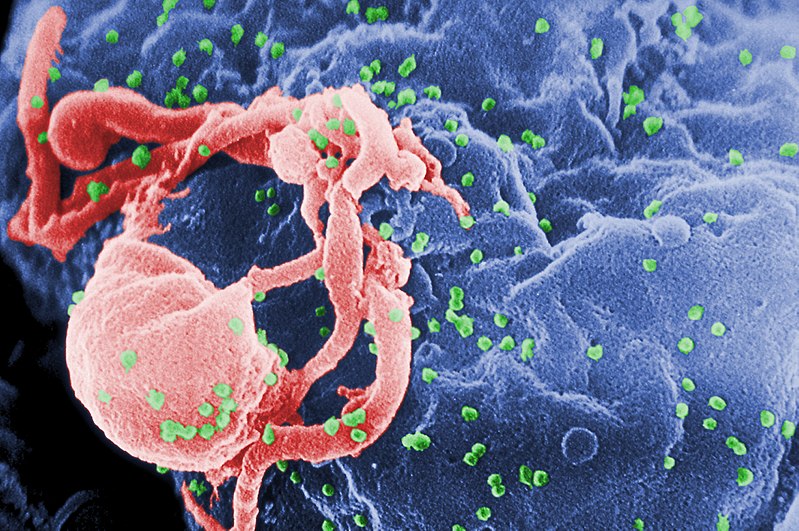
HIV-1 budding from a host cell.


Additional Discoveries
I'm sure you realize that scientific discoveries are published every day. In 2010, the U.S. National Library of Medicine and National Institutes of Health posted over 877,000 new articles and publications on pubmed.gov, a well known database for scientific publications. These publications range to new approaches to blocking malaria transmission to new genomic sequences discovered; Vaccine trial results to epidemiological analysis of target populations.

Its amazing what scientists do every day and most people have no idea. You only hear about the huge breakthroughs, but every little bit counts and contributes towards the bigger picture.

As for the New Year, I'm going to try my hardest to update more regularly, but I've set some pretty lofty goals for myself for 2011, so I hoe you'll understand if I do slip up occasionally. Hopefully, this year, I'll be one of those 877,000 papers, and I'm also working on a chapter for a textbook. We'll see how it all pans out.


Here's to a scientific 2011, one hopefully filled with many entries on Under the Microscope!


*Note: I had nothing to do with the discovery of this microorganism. Tricked you!