Showing posts with label Outbreaks. Show all posts

Sunday, March 20, 2016

Elizabethkingia: The Bacteria That Kicks You While You're Down

What's your biggest fear? Sharks? Heights? Cancer?

Compared to exciting threats like sharks, or falling to your death when your bungee cord snaps on your honeymoon bungee jumping excursion, infectious diseases fall pretty low on the list for most Americans. We've eradicated a number of diseases through rapid urbanization/industrialization (did you know that malaria was endemic in North America in the early decades of the union?), large-scale waste management (bye, cholera!), and widespread use of vaccinations (see: smallpox, polio, etc.).

An agar plate of bacteria and mold, from NationWell

There's a number of things to which Americans are not immune, and a large category of them is bacterial infections. I say "category", because the variety of pathogenic bacteria in the U.S. can be broken into a number of subdivisions, such as: sexually transmitted infections (those which are caused by bacteria), antibiotic/antimicrobial resistant bacteria, those spread by environmental exposure (like Borrelia spp. that causes Lyme Disease, which is transmitted by ticks), and nosocomial bacterial infections (also known as hospital-acquired infections), just to name a few.

The most well-known subdivision I mentioned above is antibiotic/antimicrobial resistant bacteria. In fact, over two million people in the U.S. are infected with antibiotic/antimicrobial resistant bacteria each year. You can dig deeper into the world of antibiotic/antimicrobial resistant bacteria on the CDC website, which rates bacterial species based on the severity of the threat they pose

Nosocomial infections, specifically, caused approximately 1.7 million infections and resulted in  99,000 deaths in 2002 (according to an estimate report from the National Nosocomial Infections Surveillance System). A similar surveillance survey by the CDC in 2011 reported over 720,000 nosocomial infections in acute care hospital facilities.

Get more information on the CDC's Hospital-Acquired Infection Data and Surveillance Report here.


I bring this up because in the span of 4 months, a bacterial infection called Elizabethkingia anophelis has killed 18 people in Wisconsin and 1 person in Michigan.


Elizabethkingia is the phylogenetic genus of 4 related species of gram negative bacteria:
  • E. anophelis, which causes respiratory infections in humans, and was originally isolated from the midgut of Anopheles mosquitoes
  • E. endophytica, which is a plant pathogen that mostly infects Zea Mays, or sweet corn
  • E. meningoseptica, which causes severe meningitis and sepsis in newborns and infants (premature newborns are particularly susceptible)
  • E. miricola, which was miraculously (pun!) isolated from condensation water on the Russian Space Station, Mir.
The genus is named after Elizabeth Osborne King, a clinical microbiologist (and a #WomanInSTEM!) who worked for the CDC in the 1940s through the 1960s, and studied meningitis in newborns. E. anophelis is common in environmental reservoirs, such as water and soil, but rarely causes infections in humans. The CDC logs only a handful of reported cases in the US each year.  

Yet, in Wisconsin, approximately 54 people have been infected since November of 2015. The outbreak is mostly affecting people who are 65 years or older, most of which had underlying health conditions. E. anophelis infects the bloodstream and occasionally the respiratory tract, causing nonspecific symptoms, including fever, chills, shortness of breath, and cellulitis. Death is usually a result of sepsis.

The current outbreak has been tracked across 12 counties, but has not specifically been labeled as a hospital-acquired infection. Infections of the current outbreak have been centered in the southeastern quarter of the state, including the Milwaukee area and surrounding suburban counties. One case in Hong Kong illustrated that the infection can be spread from mother to child. E. anophelis is an antibiotic resistant species, which is why the magnitude of the current outbreak is causing such alarm for medical professionals. Transmission from person-to-person is highly unlikely without blood-to-blood contact, meaning there must be another common source within the community. The transmission route for the most recent outbreaks that occurred prior to the current one in Wisconsin, one in Central Africa and the other in Singapore, was not determined.

So, how does this factor into our biggest fears? The infectious disease world is constantly discussing the concept of "emerging diseases", meaning rare infections that are suddenly migrating to naive populations (meaning, the population of that geographical region has never been exposed to the pathogen before) or are infecting new populations. Antibiotic resistant bacteria, like Elizabethkingia anophelis, are sometimes included in the description of emerging diseases because the acquired or developed resistance poses new problems for treatment and infection control.

Say you go to the hospital because your appendix has ruptured. This is a routine surgery that shouldn't take much time or effort. But being in the hospital puts you at risk for infection, especially when you are in the process of recovering from a routine, but intensive, procedure. If the infection is rare, it will take your doctor a longer time to identify the culprit. If the infection is resistant to common treatments, you will have to endure more extensive treatment programs. If you are recovering from a surgical procedure, or have other open and exposed wounds, you're immune system may be otherwise preoccupied. So, a short hospital stay that should have been routine, might end up being more extensive, or putting you at a higher risk for death.

If you would like to follow the outbreak in Wisconsin, the Department of Health Services website is updated every Wednesday regarding developments in the investigation.

Sunday, January 25, 2015

A two'fer

January: the peak of flu season, the aftermath of the holidays, and my birthday month. To celebrate all of those things, you get a two'fer today. Two subjects, one post.

Before I dive in to my two topics for today, I wanted to remind you that the Ebola outbreak is, unfortunately, still going strong. Just because the news no longer finds it new, doesn't mean it's over. Just because someone made "Ebola patient" Halloween costumes and oh, Halloween was so long ago, doesn't mean it's over (also, you should be ashamed of yourself if you donned that, or any version of that costume). As of yesterday, the outbreak has killed more than 8,600 people. I encourage you to stay informed via the Ebola Map.

Anyway...back to our regularly scheduled program:

Let's play GUESS THE DISEASE!

In 1757, a Scottish physician by the name of Francis Home proved that ___________ was caused by an infectious agent in the blood of afflicted patients.

In 1912, __________ became a "nationally notifiable" disease in the US, meaning that all health care workers were required to report all cases, as approximately 6,000 deaths were caused by _________ per year.

In the 1950s, nearly all children got __________ by the time they were fifteen years of age, causing scientists and the federal government scrambling to find a solution. In 1963, a vaccine was finally available. Thanks to the development and approval of the vaccine, the US government aimed to eradicate _________  by 1982. While this didn't completely happen, cases were decreased by 80% from 1980 to 1981.

In 2000, _________ was declared eliminated in the US.

Have you figured it out yet? Better yet, have you caught it, yet? (haha I'm so funny)

Still stumped? Here's one last hint:

Photo courtesy of the Centers for Disease Control and Prevention
It's Measles! The famous Morbillivirus is back in a big way, and is running rampant at one of the happiest places on earth. Measles (or Rubeola) is a highly contagious negative-sense single strand RNA virus of the paramyxoviridae family that is illustrated by symptoms in the respiratory tract, skin, and immune system. The obvious rash (seen above) is often accompanied by a hacking cough, Koplik's spots, red eyes, and high fever. Measles is an airborne virus and is dependent on aerosolization (coughing, sneezing) in order to spread properly. The virus can "live" in aerosolized droplets for up to two hours on a surface. Assuming there are no complications, measles usually runs its course in about 7 to 10 days (like a gross case of the flu).

So, why do we care? Why was the US government in a rush to eradicate such a disease?

Measles is really prominent in children, and children usually don't have an immune system that can withstand stubborn viruses with a history. A lot of children (actually one out of every 20 kids infected) end up developing pneumonia as a result of a measles infection, which is actually the leading cause of death from measles in young children. About one out of every 1,000 children that are exposed to measles can develop encephalitis, which can cause permanent brain damage due to excess swelling. Ear infections associated with measles (affecting 10% of infected kids) can result in permanent hearing loss.

It's estimated that over 16 million people visit Disneyland every year, with attendance fluctuations based on holidays and common school schedules (like summer break). That's almost 45,000 people PER DAY in a place were everyone is touching everything from handrails to harnesses, from interactive displays to the bric-a-brac in all of the shops.

In the latest measles outbreak, that officials are saying started at Disneyland, a handful of employees were also infected. I bet a lot of those employees were vaccinated as children, but since Disney hires people from around the world (I say this as a fact that I applaud because everyone should be able to live out their dream of working at Disneyland... and because I desperately want to be Maleficent), I bet a good chunk of their employees didn't grow up in areas that enforce strict vaccination requirements for school-aged kids. Vaccination requirements vary by state, by country, and some are better enforced than others. Plus, school-based vaccination requirements don't usually include home-schooled kids.

I'm not going to launch into some diatribe on how I feel about vaccinations (I'm sure you know already if you read my blog regularly), but I will say that the MMR vaccine (that's Measles, Mumps, and Rubella in a combination vaccine) has lead to a 99% reduction in infections, compared to the pre-vaccine era (prior to 1963). If you aren't sure about your vaccine history, I heavily encourage you to go get an Antibody Titer Test done. A titer will tell you what antibodies you have the ability to produce, whether from vaccines or direct exposure, and will tell you which ones your body isn't able to currently make, meaning you haven't been exposed, or you need an additional vaccination or booster. Not only could this simple test save your life, but it could also save the lives of others that may not be able to fight off diseases. If you're vaccinated, it's like saying "Hey disease! You'll have to get through me first before you can infect this baby, that old lady, or that person with a compromised immune system. OH WAIT, YOU CAN'T!"...and suddenly you're a hero.


I also want to remind you that its not just Disneyland, and its not just measles. Think about how many people you encounter every day, and how many people your family members encounter. Who knows what you've touched! I take the bus every day to work, and I can't tell if it's making my immune system stronger, or taking years off of my life.


Speaking of taking the bus, here's your second subject!!

I've been reading a lot since I've started taking the bus to work. I mean, reading for fun. This is the first time in probably 20 years that I've really had time to read for fun, to read for ME, and I love it. In fact, I've already finished my first book of the year, and while it wasn't science-related, there were some topics that really interested me.

The book I just recently finished (because I seriously couldn't put it down) was Unbroken by Laura Hillenbrand, which details the life of Louis Zamperini and his experiences during World War II. It is heartbreaking and amazing. I cried multiple times on the bus while reading this book (what, Zamperini reminded me a lot of my late grandfather, so it was extra emotional for me).

I won't spoil the book, but there are a number of chapters that talk about the life of American and Allied men that were caught and held as POWs in Japan. One of the most prominent health issues that was seen in these camps was beriberi. Beriberi is an illness that occurs as a result of severe thiamine (vitamin B1) deficiency, without infectious agent, and presents in two ways: wet beriberi and dry beriberi.

Wet beriberi affects the cardiovascular system, causing shortness of breath, increased heart rate, and swelling of lower extremities. Dry beriberi, or Wernicke-Korsakoff syndrome, affects the nervous system, and can cause loss of feeling, paralysis, difficulty walking, mental confusion, strange eye movements, pain and vomiting. Both wet and dry beriberi can become severe very quickly, and can lead to permanent damage and death.

Thiamine deficiency is common in developing countries, especially regions with restricted access to food due to war, severe economic conditions, and environmental conditions that make it difficult to grow or access food. I bring this up because it's easy to read a book like Unbroken, and think about beriberi as an issue that only hurt POWs during WWII, because you stop hearing about it once you finish the book. I encourage you, as you read books or whatever you're looking a online, to do further research and teach yourself something new. LeVar Burton would be proud of you.

Wednesday, August 27, 2014

Clearing the Mass Miasma

I’ve had a number of inquiries about the Ebola outbreak, whether for clarification (“what is Ebola?” or “should I be scared?”) or desperation (“I don’t know what to believe anymore!”). Let me start by saying that it’s OK to be confused or a little nervous. The media has done a great job at reporting on this terrible and unfortunate situation, but has done an even better job at making people nervous or question their ability to prepare for such a situation in their own town.

It’s always been a little aggravating to me that most science reporters or science writers don’t have a science background. There are a lot of benefits to that, such as their vernacular may not be jargon-heavy, or they might be able to cover a wide range of topics on a broad, elementary level. But, there are also a lot of writers that are feeding into the media-based hysteria to get more clicks. How do you get people to read your stuff? Scare the crap out of them.

You really can’t escape it. I’ve seen posts on Facebook to articles that detail inaccurate methods of Ebola transmission (thanks, “friends”…), and I even heard about it on the radio. Whenever I drive into work, I usually have the radio on so I can get traffic updates. A week ago, one of the personalities on a stupid morning show was talking about the isolated testing for Ebola that was happening in Sacramento (which actually happened for some missionaries, that much is true), and it really made me sad, because it solidified how little people feel they need to research the stuff they read online. Everything the deejay said was inaccurate, and all I could think about was the hundreds (thousands maybe?) of people listening at that moment...and believing everything.

But I’m not writing this to call people stupid, or make anyone feel bad about their news choices. Instead, I’m writing to give you the facts of what I’ve gathered so far. I’m not on the front lines, and I may not be a popular blogger or writer for Jezebel or Huffington Post, so I’ll it up to you whether I’m contributing to they nonsense or not.

So you want to understand Ebola. Where do you start?
If you want to understand the virus itself, you can read some of my previous entries on Ebola.

There are only a few places in the world that are allowed to research and work with any and all strains of the Ebola virus. For a long time, that list was limited to only major governmental agencies (CDC, etc.), especially research agencies that have the capability to work with biosafety level – 4 (BSL-4) pathogens. You can read more about BSLs here, but I’ll break it down for you:
  • BSL-1: all microorganisms used are not known to consistently cause disease in healthy adults and present minimal potential hazards to lab members and the environment. A good example of this is non-pathogenic E. coli, which is used in almost every lab that has ever existed. Think everything from entry level biology classes to, well, most other labs.
  • BSL-2: In addition to being able to work with BSL-1 organisms, BSL-2s can work with organisms that pose a moderate risk or hazard to lab members and the environment. A good example of this is Staphylococcus aureus.
  • BSL-3: This is a restricted environment, as the hazards are increased from BSL-1 and BSL-2. The pathogens or organisms researched in these labs can often cause lethal diseases via respiratory transmission, like Mycobacterium tuberculosis which causes tuberculosis.
  • BSL-4: Lab work involves microorganisms that are dangerous and exotic, and may or may not have a defined method of transmission yet. This is where Ebola is researcher. Researchers who work with BSL-4 organisms have to change their clothes before entering the clean room, and must shower and decontaminate all materials before leaving the research space. These researchers have to wear full body, pressurized, and air-supplied suits. This is the solitary confinement of pathogen research.
Image from Frankfurter Rundschau

Get it? It’s incredibly dangerous, and you should thank the researchers that risk their lives to perform the groundbreaking experiments that they do. If you want to read the follow-up report regarding a researcher accidentally becoming exposed to Ebola, you can download that here.

Am I at risk of becoming infected?
Unless you are a health care worker who is working with individuals who are infected and currently experiencing symptoms, your chances of contracting Ebola are slim to none.

With that being said, the only known method of transmission for Ebola is direct contact with the bodily fluids of an infected individual. If you have traveled to Africa recently, and have had contact with someone else’s bodily fluids, you may want to check in with your doctor. Once someone has recovered from the virus, they are typically no longer contagious, but the Ebola virus has been shown to be present in semen for up the 3 months post-infection.

This isn’t like our seasonal flu. Ebola is an incredibly debilitating infection that can have symptoms including high fever, headaches, muscle pain, vomiting and diarrhea, and unexpected bleeding or bruising. There have been some really sad stories about churches, mortuaries, and even entire towns banning traditional funeral and burial practices because it puts otherwise healthy people at risk.

Will the outbreak spread to the US?
The CDC has not indicated any potential risks for the outbreak to spread. Yes, there have been medical professionals and missionaries that have contracted Ebola during this outbreak, and yes, they have been brought back to the US for treatment.

BUT, there is a reason for that. Almost all the major research that has been done to figure out the Ebola virus has been conducted in the US (or in collaboration with the CDC). Experimental treatments are here, better medical facilities with isolated rooms and chambers are here. 

Let me put it this way: As of right now, there are 2,615 cases of Ebola between Guinea, Sierra Leone, Liberia, and Nigeria. There are more than 1 million individuals who are infected with HIV in the US, and 1 in 6 of them are unaware of their infection (typically due to negligence with regular testing). HIV is also spread through direct contact with bodily fluids. But, every time you go into a hospital, you don’t panic about HIV because medical facilities are prepared to handle and minimize these types of risks. Take a deep breath and don’t believe everything Donald Trump says.


What. an. ass.
OK, I believe you about the risk of getting Ebola in the US, but I’m still paranoid and want to track it every day.
That’s fine. Check out this amazing website that will give you a detailed update every time something happens with the outbreak. You can also watch an illustration of the spread of the outbreak since March 14, 2014.

What about treatments? Why aren’t there treatments?
There are currently 3 companies working on developing experimental treatments against the Ebola virus: Tekmira, Biocryst Pharmaceuticals, and Mapp Biopharmaceuticals. All of them are in very early stages of development, meaning none of them have been approved for use in humans. ZMapp is the product that is getting the most media because the experimental monoclonal antibody-based therapy was given to two US patients in Liberia.

Since this experimental therapy has not been approved, it requires each patient to consent, and understand the potential risks associated with experimental, non-approved therapies. Compared to some of the other funded research, Ebola isn't seen as a major threat. Maybe that's because we haven't seen an outbreak this large before, or that it hasn't been a threat to the US yet. Either way, it's getting the attention it needs now to really get some momentum in terms of pushing drug and vaccine development through to (hopefully) a reality.

It is possible for patients to recover and survive an Ebola infection. In order to do this, the patient needs constant monitoring for fluid balance, oxygen and blood pressure, and additional treatments for complicating infections.


This is a lot of information to digest, so I'm going to leave it at that. If you have any other questions that you'd like answered, feel free to let me know!

Saturday, January 14, 2012

Common scientific myths that are regularly exploited by mass media

I'm a gmail user, and I have my iGoogle news widget set to show me all the "health" related news (if you've seen this setting, then you understand why I use parentheses with the word health). There is always at least one laughable article each day. While this is funny, it's also really scary.

I mean, around the time of the listeria outbreak in cantaloupe, there were 1,600 articles a day that clearly stated "OMG DON'T EVER EAT CANTALOUPE EVER AGAIN!" Was that necessarily helpful? Is that considered informed reporting? Not everyone wants to read scientific articles for accurate information. I mean, I don't even want to read them (that was a lie). Scientific writing is different. It's blunt and bland, lacking any decoration. But, it's also very important.

So, on Friday, I sat down at my desk at work and opened up my browser to see a particular article that lit a fire under my butt faster than a bunsen burner attached to a leaky gas valve (insert fart joke here). Everything about it was wrong, and it scared me! So, I decided to round up a few myths about recently popular science topics.

Myth #1: Just about everything you've ever heard about HIV or AIDS from mainstream media.
If you know anything about me, you'll know that this is my biggest pet peeve (well, that and chewing with your mouth open, but I digress). Since the beginning of the HIV/AIDS epidemic in the 1980s, mainstream media has disregarded scientific progress and facts when reporting on the matter. We've heard everything from "AIDS is a gay disease" to "the government created HIV to scare the American public into submission", and every idiot thing you can think of to fit in between. My favorite is "HIV isn't real".

...oh, right. Why don't you tell that to the 43,000 people, in the United States alone, that were diagnosed with new HIV infections in 2009.

The article that actually inspired this blog entry ['HIV was invented as the cause of AIDS to get research money' claims radio host] can pretty much be summed up in this video. Need I comment on this?

Last year, news of a research breakthrough exploded all over the world. "Finally! Scientists have cured a man of AIDS!" It was everywhere, but it's not exactly...oh, what's the word I'm searching for...reasonable? Yeah, that's it! Bone marrow transplants are difficult and expensive. You must have a very specifically matched donor to avoid any complications (ie- rejections or immune responses to the foreign matter).

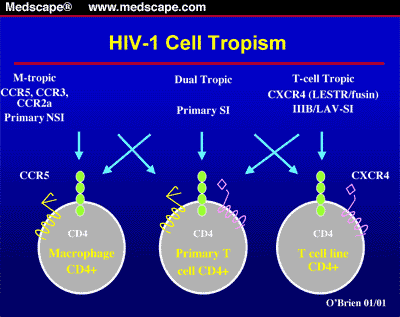
The concept behind the bone marrow transplant was based on the delta32 mutation. Discovered in 2005, the delta32 mutation allows a fraction of the population of Europe to show signs of immunity towards HIV-1 infection, but not all types of HIV-1 infection. Viral tropism allows for different strains, or variants, of the virus to use different co-receptors that are naturally expressed on the host's cells, primarily T-cells. CCR5 and CXCR4 are the two co-receptors that are primarily used for access to the host cell. These co-receptors are also used to elicit a cell-mediated immune response. Due to viral tropism, different strains utilize different co-receptors for viral entry into the host cell. That is, HIV-1 strains that use CXCR4 don't necessarily need CCR5 co-receptors for entry. Therefore, individuals who have the delta32 mutation are not 100% immune.


People are all too quick to jump on the opportunity to say "We've done it! We've cured AIDS!" We saw this in the dawn of medicinal cocktails, and we'll see it again. But, the magnitude of this disease is so great, that the types of breakthroughs we are making right now are not satisfactory enough. We cannot feasibly give every HIV-positive person a bone marrow transplant, but we can turn to the micro-science behind the theory of why this works. We can't look at HIV medication, because they are expensive, extensive and not available to everyone, but we can look at making more affordable and readily available drugs. It's one thing to be blanketly hopeful; it's another to be realistic.

Myth #2: Food poisoning is limited to meat products.
This is an easy one. The probability of getting a food-borne illness does increased when livestock involved (POOP, EVERYWHERE!), but also has to do with the fact that most people don't effectively cook their meat. Let's face it, there is poop covering everything on this planet, whether it's from humans, animals, or insects. That is why we have immune systems.

This is something I hear a lot from people, because I'm vegan. "Have you read Fast Food Nation? Did it scare you into your dietary choices?" Just stop it. It's not about any book or any food-borne pathogen. We've gotten to the point to where our food is so mass-produced and unproportionally regulated that we are bound to run into problems, no matter what we choose to put in our mouths.

Interestingly enough, wikipedia has a very extensive list of food-borne illnesses, listed chronologically by year. Some of the deadliest, actually have been in cantaloupe, peanuts, spinach, bean sprouts, green onions and apple juice. By all means, take this into account, but don't let it scare you away from the ever important "green group" on the food pyramid (or plate, or whatever you want to go by).  Take actions into your own hands, and look at where you are getting your food from, and how you are preparing it. I've already written about the horrors of food (and feel free to refresh your memory!), and I'll probably do it again.


Myth #3: Immunizations will give your child autism.
Oh, Jenny McCarthy, you gorgeous idiot. I thought this issue was left behind with the early 2000's, but apparently I was wrong.

According to facebook, everyone I know is pregnant right now, and everyone is posting about issues like "is breastfeeding wrong?" or "does Baby Einstein really work?" Sure, whatever. I'm all for people trying to decide what is best for their child, and using whatever resources are available to them to do so. But, one of my friends started posting videos (this one in particular) about the horrors of vaccines, and stated that she was trying to decide what to do for her newborn (while logically consulting youtube).


Instead, why don't you start with the CDC's take on Vaccines and Autism. A scientific review by the Institute of Medicine (IOM) concluded that "the evidence favors rejection of a causal relationship between thimerosal-containing vaccines an autism." The CDC supports the IOM conclusion. Also, here is an article from 2007, titled Vaccines and Autism, by Dr. Brown, that talks about immunizations from a medical perspective. Both the medical and scientific communities reject Jenny McCarthy's claims that vaccines cause autism.

Nevermind that the first vaccination demonstration in 1798 would lead to the eradication of smallpox in 1980. Or more recently, nevermind the fact that polio has almost been eradicated in India due to vaccinations. Oh, I get it, you're worried about what vaccines will put in your child's body, but you'll feed them McDonalds. That makes sense.

I understand they hysteria of wanting to do what's best for your child, but I will never understand taking medical advice from a model (oh wait...she was "Playmate of the Year" in the 90's, so that's like getting a doctorate, right?), or from youtube.

Let's talk about health the health of children around the world.


There are plenty of other myths out there that I'd be happy to discuss. Just send me an email with your requests.

Also, my belated apology for not writing more frequently. I've been working very hard lately to get two grants, and things are starting to pay off (literally and figuratively!). 

Sunday, October 24, 2010

Love in the time of Haiti


Ahh, Cholera, what an interesting history you have. Such a small bacterium can definitely grouped in with the most historically significant pathogens in the history of humans. And, although we've figured you out, you still never cease to infect us.

If you aren't hip to reading news, or science/health news specifically, then you probably aren't aware of the fact that Cholera is ripping through Haiti's rural towns and has made it to the capital. This is important, for historical reasons...and because Cholera kills 100,000 to 120,000 people every year.

Lets take a little trip through the pathogenic history of Vibrio cholerae.

1816 - 1826: The first recorded outbreak and epidemic of Cholera struck Bengal and spread through China, Indonesia and the Caspian Sea with British troops. It is estimated that 15 million people died during the ten year tour of Cholera.

1829 - 1851: Russia, Hungary, London and Paris are all affected. Scientists scrambled to figure out the method of transmission of Cholera, while mass hysteria hit the major cities. The media coined the term "King Cholera" (which is of the same caliber as calling H1N1 "Swine Flu", in my opinion). 


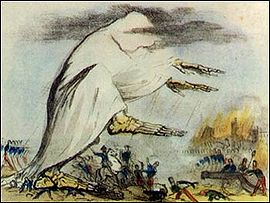
This was a specifically crucial time in the development of Epidemiology. Many scientists were throwing out disease theories in hopes that one would stick. William Farr proposed the Miasmatic Theory of Disease, suspecting that Cholera was spread through "bad air" or "poisonous air".

Sorry, William Farr, you were wrong. But, many grim, black metal-esque illustrations were created to emphasize the false truth of this theory.

 Remember, at this time in history, faith-based disease theory and healing were still alive and widely believed. If it wasn't the deadly diarrhea that scared you, then the giant Cholera spirit surely would.

I shouldn't admit that I was tempted to make an AC/DC reference as the caption for that photo...

Anyway, John Snow, a British physician, took the cake with his theory on the spread of Cholera in 1854. Snow discovered that Cholera was being spread through use of contaminated water pumps that were being sourced from a well that was only 3 feet away from a cesspit. He discovered this by going door to door and surveying the people about their symptoms, and the source of their water. People actually told him that the pump that was, unknowingly, contaminating everyone was the source of the best water in town. 

...maybe it was the added benefit of a gram negative bacterium.


 Following the UK and Europe's Cholera outbreak, the bacterium spread throughout Asia, Africa and South America. There have been outbreaks in North America, but nowhere as severe and widespread as those in Africa and South America. 

So this brings us back to Haiti. Ten months ago, Haiti endured a 7.0 magnitude earthquake that left 1,000,000 people homeless. Most of these people have used any resources available to create a "tent cities" (Haitian hooverville?) throughout Haiti, yet mostly centered near Port-au-Prince. Earthquakes, obviously, affect sewage and sanitation, so it was really only a matter of time before we heard about an outbreak of Giardiasis or Cholera. On top of that, 230,000 people died during the earthquake and subsequent aftershocks. Now, Haitians must live amongst ruined sanitation efforts and mass graves.


Over 200 people have died from Cholera in Haiti in this latest outbreak. Cholera can kill its victims pretty quickly if not treated adequately. There is typically a period of 2-15 days between infection and symptoms. Most people that are infected with Vibrio cholerae experience terrible fits of diarrhea, fever, sometimes vomiting, and extreme dehydration.

Approximately 80% of illnesses in developing countries can be attributed to their poor sanitation and lack of adequate water sources. There are non-profit organizations that are working to address this issue. Many organizations have attempted to give aid and develop programs to bring clean, safe water to communities in need, but have failed to realize that they need to focus on the sustainability of the project, as well. How feasible is it for these communities to maintain the project after relief and aid efforts have left the area? Where is the money going, exactly? What are the needs for upkeep and use of the project?

If you are thinking about donating to an organization that addresses water issues, make sure you read up on the sustainability of their program. The Water Project has emphasized the sustainability of their program, and it seems like a reasonable effort.  You can check out their completed projects here.