Showing posts with label intestinal. Show all posts

Saturday, March 21, 2015

Taenia solium and the leaky brain cyst

For my other blog (warning: not a scientific blog), I wrote a little thing about why Spring is one of my favorite seasons (I mean, second to Autumn of course!) because it brings an abundance of cute baby animals to the world. One of my absolute favorites is the pig! Domesticated, wild, big, small, it doesn't matter.

Image from Daily Mail.
So, in honor of all the piglets being born this season, let's talk about a classic parasite with some new research twists. Taenia solium is a type of tapeworm that is specifically linked to pigs. T. solium is related to the "beef tapeworm of man" (Taenia saginatum, tapeworm associated with cows), but can cause some much more severe symptoms.

T. saginatum scolex imaged using electron microscopy. Image taken from the internet.
T. saginatum, the beef worm, is what everyone thinks of when they think "tapeworm": adult worms have a head, neck, and proglottids, and causes intestinal obstruction and discomfort. Oh, and it can live inside of you for up to 25 years!

In order to get your own tapeworm infection, all you have to do is consume poorly cooked beef which contains T. saginatum eggs. When the eggs "hatch", oncospheres (infective larva) migrate to the small intestine, where they will take 3 months to mature into an adult worm. Adult worms are typically 2 to 10 meters in length. Usually only one worm is found, unless you've consumed a heavily contaminated piece of meat or ate fecal matter that's full of gravid proglottids (the end pieces of the tapeworm). Fun fact: eggs can survive for months once they've left the body. Beware of old poop!

Taeniasis life cycle for T. saginatum and T. solium, via the CDC

Patients infected with a beef tapeworm (clinically described as "Taeniasis") may complain of non-specific abdominal symptoms, such as nausea, general pain and discomfort, or weight fluctuations. I say weight fluctuations because most people experience extreme weight loss (often misdiagnosed as anorexia), especially those affected in developing countries (where these parasites are most prevalent), but there have been a number of people who have infected themselves, by choice, and have reported it being "no big deal" or that they gained weight (see my favorite example: Michael Mosley of the BBC News). So, while most people experience weight loss, I suppose you could say that depends on your socioeconomic status, and whether or not you've had a choice to become infected.

T. solium life cycle from the Food and Agriculture Organization of the United Nations (fao.org)
T. solium can also cause all the same intestinal symptoms, and can live out a life cycle similar to that of T. saginatum. But, in some cases, T. solium can cause something called Neurocysticercosis (cue scary music). T. solium's life cycle and pathophysiology usually looks very similar to that of T. saginatum, only with smaller worms (4-7 meters in length). Neurocysticercosis occurs when you've ingested the eggs directly, such as ingesting contaminated feces. This happens to pigs when their food is contaminated with human feces (pretty ironic, right?).

T. solium scolex. Image from UNAM.
The consumed eggs hatch in the small intestines and the oncospheres are released. Oncospheres penetrate the intestinal mucosa and make their way to the blood. Once in the blood, they travel throughout the body and migrate to different tissues, where they will mature into cysticeri. The cysticeri really like skeletal and cardiac muscle, subcutaneous tissue, and lungs, but they can also get lodged in the central nervous system (CNS), including the brain and the cerebral ventricles. Once the cysticeri have chosen a tissue which to lodge themselves, they become calcified granulomas.


T. solium adhering to the epithelial cells of the intestine. Image from UNAM.
The most common location for cysticercosis to occur is the cerebral hemispheres, at the gray-white matter junction, but they can also be found in the cerebellum, the brainstem, the subarachnoid space, the basal cisterns, and the spine.

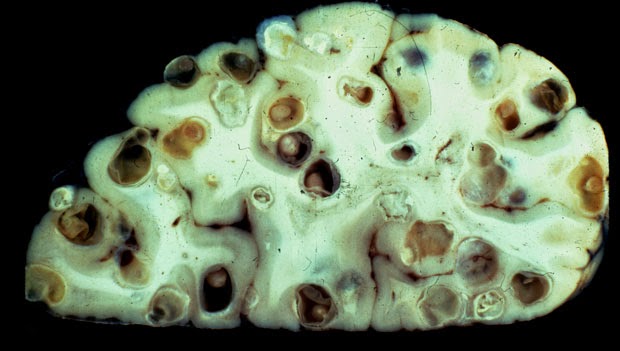
T. solium cysts in a human brain. Image from Discover Magazine.
 Obviously, having a 1-2 cm cyst calcifying in your brain will cause some damage. Neurocysticercosis is one of the leading causes of epilepsy in developing countries. It can also cause severe headaches, hydrocephaly and eosinophilic meningitis.

The National Institute of Allergy and Infectious Disease (NIAID) just released an article about the treatment-induced inflammatory response in pigs with neurocysticercosis. The current treatment of Praziquantel is apparently causing inflammation, blood vessel leakage, and damage to the blood-brain barrier. This means that new drugs need to be developed that can reduce inflammation at the site of the cyst(s) while maintaining the integrity and functionality of the blood-brain barrier and blood vessels.

Photo of the surface of the brain of a pig treated with the antiparasitic drug praziquantel showing blue-dyed (blue arrows) and clear (white arrows) cysts. The blue dye indicates disruptions in the blood-brain barrier. Image from NIAID/
Dr. Cristina Guerra-Giraldez.
This research only focuses on pig subjects, and has not yet been performed on humans infected with neurocysticercosis.


Want to avoid tapeworms and neurocysticercosis? The best way to do that is either to avoid eating meat, or to make sure your meat is cooked properly. Cooking meat properly is the best way to inactivate or kill most infectious diseases associated with meat consumption.

One of the major reasons diseases are so rampant in livestock is because a lot of treatments (mainly antibiotics) are used as prophylactics instead of at the onset of infection and symptom presentation. Animals that are raised in small, confined areas are more likely to be exposed to illnesses. When you are raising animals on a large scale and rely on them for income (whether through livestock trade, meat or dairy production), it can be really scary when one of your animals gets an infection, because you risk losing some of your income. It's obviously unethical to sell/trade sick animals, but it happens all the time, and is one of the main causes for the spread of disease to other regions. When prophylactic treatments are used, resistant infections are more likely to occur, which is an even larger problem (as I'm sure you can imagine).

Even if the meat you consume came from a healthy cow/pig/lamb/goat/chicken/turkey/etc., it might have been slaughtered in the same environment as a sick animal, which still puts you at risk. So, if you have a tendency to order your meat "rare", be sure you know the risks associated with that choice.

Edited to add:
I want to be clear that, even though I'm vegan, I believe choosing to be vegan is a very personal choice and no one should ever be bullied in to it. But, I also feel the need to add some information about the environmental impacts of eating meat to this post, since we are talking about risks associated with consuming meat. Considering the risks to yourself is very important, so you can actively minimize your risk of getting an infection or other serious health disparity (mostly through the long-term, excessive meat consumption),  but considering the long-term risks for the environment (ie- everyone on earth) is also really important. Here are some articles that you might want to consider reading before making a definitive decision about your dietary habits:

The Triple Whopper Environmental Impact of Global Meat Production: TIME

How does meat in the diet take an environmental toll?: Scientific American

Giving up beef will reduce carbon footprint more than cars, says expert: The Guardian

2500 gallons all wet?: EarthSave


Sunday, May 20, 2012

The Interlude Continues

Boy howdy, if I haven't received loads of encouragement! As I stated in my last entry, I've had to take some time away from writing blog entries so I could wrap up a few major projects. Since that post, I've received tons of emails wishing me luck, and others saying "I hope you will return to writing when you finish!" So, a gigantic thank you to everyone who wished me well in my time away from Under the Microscope.

Yet, my time apart is not completely over. I'm currently in San Diego for a collaborative work project with The J. Craig Venture Institute, and when I return to the Bay Area, I will be quickly hopping on a plan for a few weeks for a much needed vacation. I will try to write in the meantime, but promises are always futile.

...

I drove to San Diego instead of flying, partially because I wanted to bring my bike with me, and partially because I wanted some time alone to think. I spent a lot of time listening to old podcasts from Radiolab, which got me thinking about future blog posts. Trying to decide what to write about next is troubling for me, believe it or not. Writing is not a natural habit for your truly, unless its in a lab notebook. I can remember all of my major writing accomplishments throughout my personal history, as they were few and far between. In the seventh grade, I chose to write my literary research paper on the bubonic plague, narrated by the only unaffected living thing in the town: a tree. Oh, twelve-year-old me, you were so dark, so profound! I had clearly been listening to too many records by The Cure. The next was my Advanced English research paper that I chose to do on Bram Stoker, and other historical works which focused on vampires. If I would have known, at age sixteen that Twilight would be a thing in future times, well, I would have been a rich little idiot.

Anyway, I struggle with deciding on future topics for Under the Microscope. There are too many species, too many diseases, too many, too many, too many! But listening to one old Radiolab podcast in particular reminded me of why I write. I highly suggest you dedicate an hour to listening to this show, titled Parasites, from 2009.


Carl Zimmer has always been a role model of mine (ok, I'll admit it, I have a crush), as he often takes the side of the parasite. Not only is this rare, but it's exactly the standpoint that I've always taken. Think about it: humans are, without a doubt, the most advanced life form of which we know, yet we can easily be challenged and occasionally defeated by "lesser" life forms. Parasites, some of which are even single celled organisms, bacteria, and viruses, which aren't even considered to be "alive"! Sure, we've evolved and developed habits and methods to limit our exposure and risk of such encounters, but they don't always work.

This show about parasites always makes me laugh when I listen to it because people always ask me if I've ever heard of Jasper Lawrence, or "that guy that sells worms". I never really know how to react, because I do applaud Mr. Lawrence for taking his medical care into his own hands (or should I say gut?) and I am totally happy that shows like Radiolab have made that sort of science accessible to everyone... but starting your own business off of it is a little sketchy. Mr. Lawrence keeps a blog associated with his business, wherein he describes his family life and his allergies. There is one entry where he discusses the risks associated with obtaining hookworms in the wild (ie, naturally), but it's basically just a review of wikipedia pages.

So, maybe I should talk about hookworms? I've written previous entries on tapeworms and other types of parasitic nematodes, but I can't recall an entry that specifically focused on hookworms.

Ascariasis and infections by Ancylostoma duodenale and Necator americanus are pretty harmless, and while uncommon in the United States, it is highly prevalent in other regions of the world. You often find prevalent hookworms in areas where modern plumbing is unavailable, and human feces is used in fertilizers. Poop everywhere!


The filariform larvae of A. duodenale and N. americanus cause infection by burrowing into the skin, typically around the feet or ankles when exposed in shallow waters or muddy areas where infected feces is present. In instances where feces is used for fertilizer, Ascaris eggs can be ingested with fruits and vegetables that are not thoroughly washed.


Once in the body, the adults attach to the lining of the small intestine and feed on blood and protein sources. There are very few symptoms associated with a hookworm infection, and many people are unaware of infections that they've had for years! If an infection is particularly heavy, the individual can experience anemia and protein deficiency.

What's amazing about these creatures is that they've phenotypically adapted to their ideal environments. They may be blind and deaf, but there are many different types of hooks and "teeth" that allow them to anchor themselves to one tissue surface for years. I've always imagined the following nerd references when studying hookworms and tapeworms, but what can I say, I'm totally unprofessional.

Credit: Dan Meth

In the real world (sighhhhh), hookworm "mouths" usually have one row of teeth, like this:

This photo is entirely not scary if you imagine it's singing opera.

I should say that I've always approved of the Hygiene Hypothesis, as I was raised in an area where many people suffer from seasonal allergies, and I do not! Maybe I'm just biologicaly supreme, or maybe it's because I did have my own run-ins with a few parasites at young ages. Either way, this theory is commonly centered around the ability of your system to produce a specific types of antibodies (IgE) that are associated with allergic reactions and helminth diseases (parasitic worms).

While that is all I have time for today, I want to end by saying, once again, that I will update as much as possible. Also, I'd like to send out magical vibes to Carl Zimmer, in hopes that he might agree to have lunch or dinner (or tea!) with me when he is in San Francisco in October. Maybe?

Thursday, September 29, 2011

I'd love to marry you right now but I cantaloupe, because I just shit myself

Ah, word play. My partner and I laughed for a good hour last night about possible listeria-themed titles for my next blog update. You should have been there, it was pun-tastic.

So, I have to admit, I have been avoiding writing a new update because I just couldn't choose a topic to write about. There is so much going on right now in terms of fun diseases and outbreaks, and I don't want anybody to feel left out.

...which is why I've decided to do a quick round-up!


Listeria monocytogenes - Listeriosis
I feel like I'm the only one that actually cares about this. I've caught my parents eating cantaloupe on multiple occasions since the major listeria outbreaks hit the news. Maybe I just like to play it safe? Maybe I don't really like cantaloupe all that much to begin with? Maybe my parents are risk takers?

Either way, if you haven't heard by now, one of the "most dangerous" food-borne illness outbreaks is happening RIGHT NOW. Colorado-grown cantaloupes that were shipped to 25 states and various international countries are contaminated with Listeria monocytogenes, a very deadly, gram positive bacteria. Last year, there was a Listeria monocytogenes outbreak in celery.

You might be thinking, "why is this so dangerous? We hear about food-borne illness outbreaks all the time", but this is an interesting microbe with an interesting motive. Not only is this the first case of Listeria monocytogenes in cantaloupe that we've ever seen, but there have been almost 80 infection cases reported, and 13 people have died since the initial reports of the outbreak.

This is awesome! Original posting by Katalini here.

According to the CDC, Listeriosis can take up to one week to 2 months before you start showing signs of infection after being exposed to the bacteria. It could be in you right now! Funnnn! What's even more fun is that Listeria monocytogenes can continue to flourish in cold environments, meaning storing your cantaloupe in the fridge will not stop colonies from expanding.


Listeriosis has very diverse symptoms and can depend on how advanced your infection actually is. It can present itself as an upset stomach, fever, vomiting, diarrhea, headaches, dizziness, loss of balance, sore neck and muscles, convulsions, miscarriage, stillbirth and death.

If you think you may have Listeriosis, contact your local clinic or medical provider and request a test. The earlier the diagnosis, the better. Listeria monocytogenes is responsive to antibiotic treatment.

UPDATE: Listeria monocytogenes has just been traced to lettuce as well.


Two Heads are Better than One
Also, this happened:


I know the woman is saying "Frank AND Louie", but I really like the idea of her naming the cat "Frankenlouie".


Science Justifies Your Vices, Sometimes
Some idiot scientist decided to test the effects of caffeine and coffee consumption on women's moods and magically discovered that consuming 4 or more cups a day will improve your mood.

...I'm sorry, what? This is news?

Let's just get something straight before we jump into this. Caffeine is a stimulant drug. Yes, you heard me. While sometimes it is naturally produced, it can also be synthetically produced. Caffeine affects your central nervous system. Additionally, it takes about 12 hours for caffeine to completely leave your system. If you're drinking 4 or more cups of coffee a day, I can almost guarantee that your brain wont have a moment to rest.

Just think about it.


RIG-1 Protein Identified to Fight Viral Infections
RIG-1 is a cytoplasmic pathogen recognition receptor that identifies viral RNA from cellular RNA, which is a huge breakthrough for possible drug treatments for viral infections, such as Hepatitis C, Measles, Rabies, West Nile Virus and Influenza. Researchers discovered that some viral RNA is typically double-stranded, whereas cellular (or self) RNA is single stranded.


Hollywood Exploits Nationwide Paranoia: Contagion

For weeks, everyone has been telling me that they think of me when they see ads for "Contagion". I kept thinking it was a new public health effort to reduce cold and flu cases this year through early education. Silly me!


There are some big names in this feature! Unfortunately, I think I'm the only person on the face of the planet that would actually enjoy seeing this. So, I'm going to take myself on a date. "One ticket for Contagion, please! ...yes, it's only me. Yes, I'm lonely."

EDIT: Listen to an interview with the real virologist who consulted on the film! 

I've decided to review this movie. If you've seen it already, feel free to email me with your comments!


Sunday, April 4, 2010

Easter Infection


I had a difficult time deciding what to kick off my first blog entry with – there are so many viruses and parasites to choose from! Do I start with something basic and move onwards and upwards from there? Or do I jump right in with both feet and bombard my initial readers with my favorites?
But then I realized I should obviously go with a festive theme for Easter. I mean, that’s the logical thought, right?
Truth be told, the Easter bunny does become occasionally ill. Unfortunately, it’s usually with a brutally fatal virus: the myxoma virus.
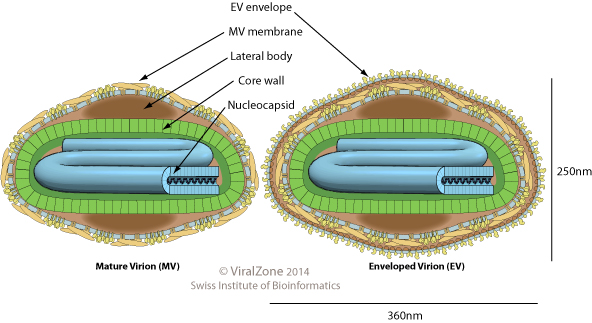
The myxoma virus is part of the poxviridae family, and is a class 1 virus within Baltimore Classification Standards. The myxomoa virus has an exterior envelope structure which encases the viral capsid and assists with viral entry to the host’s cell. This envelope structure contains many important glycoproteins that assist with entry through membrane fusion and location specific phagocytosis. Later on in the viral lifecycle, or the “infectivity cycle”, the viral envelope also assists with budding from the host’s cell for dissemination of newly matured virions. For all viruses, the viral genome is protected within the viral capsid. The myxoma virus utilizes a double stranded DNA genome that is non-segmented and linear.
 
The myxoma virus only seems to infect rabbits and hares due to components of their immune system that are easy to evade. It is not necessarily exclusive to one geographic region, although does have a higher infectivity in specific areas. High incidence rates have been reported in the UK, Australia, Egypt, France and South American (specifically Uruguay).  The South American incidents are typically not dangerous and illustrate a lower mortality rate than any other region affected. Common cottontail rabbits usually experience characteristic dermal tumors, yet European rabbits can experience severe myxomatosis. 

Symptoms of myxomatosis begin with tumors on the skin and genital areas. After spreading, the rabbits can experience blindness, fever and exhaustion. Due to the rabbit’s weakened state, secondary bacterial infections are very common and are habitually what cause the onset of the eventual death. This is usually due to swelling of the lung tissues and pneumonia. Myxomatosis is also associated with Rabbit Hemorrhagic Disease (RHD) which can cause the infected rabbit to become comatose and die. Death from  a myxoma infection can occur anywhere between 48 hours to 14 days after initial infection. 

Australia’s government decided to utilize the fatality of the myxoma virus to control the overwhelming rabbit population. Initial experiments for population control “successfully” reduced the rabbit population from 600 million rabbits to 100 million rabbits over the course of two years. I can’t imagine what wading through rabbit carcasses decorated with tumors would be like. I mean, 500 million is a lot of dead rabbits. 

The virus is spread through direct contact with infected rabbits, and also through insects that take blood meals, such as mosquitoes.  It’s still a pretty rampant problem, thanks to governmental abuse for population control, and has lead to the development of a vaccine for those who wish to keep pet rabbits.
So, don’t be alarmed if the Easter Bunny didn’t quite make it through his rounds of delivering baskets. You might be the lucky one that finds a lumpy rabbit carcass amongst your chocolate eggs.

As far as festive parasitic infections go, Iodamoeba butschlii takes the egg-shaped cake.
Iodamoeba butschlii, as you can see from the name, is an amoebic parasite. It does infect humans, but is considered mostly non-pathogenic. Generally, these little buddies reside in your large intestines and feast on the excess yeast in your system. Rarely do people experience symptoms, but if they do, it’s generally just mild diarrhea and stomach cramps.

 The festivity is in the structure of the parasite, not necessarily the function (I mean, nothing says Happy Easter like mild diarrhea and stomach cramps!). Iodamoeba butschlii is one of the smaller parasites, with an average cyst size of 10 µm. It has all the normal components of an amoebic parasite, such as a nucleus, endosomes, etc., yet can be easily diagnosed because of its abnormally large glycogen vacuole! Why am I so excited about this glycogen vacuole, you wonder? Well, it is the key to our festive riddle!
Scientists, being the witty and intelligent creatures that they are, decided that this glycogen vacuole paired with the ovoid shape of the cyst makes Iodamoeba butschlii look like an EASTER BASKET! Take a look for yourself:

Don't you just want to put all your eggs in that little basket? An Iodamoeba butschlii infection can be diagnosed through a fecal wet mount. Exciting!

So with that, watch out for excess rabbit carcasses and avoid eating focally contaminated food this Easter.
Happy bunny day!

p.s.-  Radiohead's Myxomatosis: