Showing posts with label parasites. Show all posts

Saturday, November 11, 2017

Cats, Bats, and Rats: Harbingers of Diseases of Disparity

On Monday, I attended a symposium, titled "One Health: Interface of Human Health/Animal Diseases", at the American Society for Tropical Medicine and Hygiene (ASTMH) annual meeting (aka #TropMed17). This was one of many sessions I attended, but one of the few that really stood out to me.

I love the concept of One Health, which emphasizes the interwoven nature of the environment, animals, and humans, where a change to one aspect of the world will affect the other surrounding environments and populations. This is a vital concept when it comes to global health, as we often focus on human disparities without working to improve the person's environment for sustainable health and change. As you can imagine, One Health is a critical component when describing the lifecycles of zoonotic diseases, which infect both animals and humans. I wrote a magazine article for The Biochemist about the impacts of One Health on disease emergence. You can find that here (e-zine) or here (PDF), for free.

Within the One Health symposium, each speaker outlined an important animal exposure for each infection, whether parasitic, viral, or bacterial. For example, the first speaker discussed an outbreak of hantavirus in Peru during the creation of a new interoceanic highway that runs across Peru and Brazil. Deforestation and construction created a new opportunity for exposure to hantavirus for construction workers and residents in the area. Here's some more info on that, if you are interested.

Image of bats emerging from the Swedagon Pagoda in Myanmar, borrowed from an article on Biodiversity via ResearchGate
Another speaker spoke about emerging pathogens in Myanmar due to exposure to bats through the use of caves for economic (mostly the creation of tours for tourists) or religions purposes (think shrines in caves). Myanmar apparently has 22% of world's species of bats, meaning it has a diverse population of bats, and they are everywhere.

The two talks that I really enjoyed covered parasitic infections that are a global issue affecting primarily low income populations, even those in the United States.

Beautiful illustration borrowed from The New Yorker
Angiostrongylus cantonensis, or "rat lungworm", is a parasitic nematode that is found throughout Southeast Asia and the Pacific basin. Rat lungworm causes eosinophilic meningitis in humans. Humans are exposed to A. cantonensis through ingestion of infested foods, like undercooked or seafood, fish, frogs, vegetables, or snails.

An apple snail, image borrowed from Hidden History
 Apple snails act as a reservoir for A. cantonensis throughout Southeast Asia. Upon investigation, the larval stage of the nematode can be found invading the lungs of the snail. Adult A. cantonensis live in the pulmonary arteries of rats, and larvae migrate to the pharynx, where they are swallowed by the rat and dispelled in the rat's feces. The larvae are then ingested by the apple snail, or other specific mollusk species.

The apple snail can be purchased to eat from stands along the road in Laos, Cambodia, and Thailand, or the larvae can infest other aquatic animals. Once ingested by a human, the nematode travels to the brain through the blood stream, and then dies shortly after. The presence of a foreign body in the central nervous system causes a flood of white blood cells, specifically eosinophils, which triggers inflammation of the meninges. While this can clear on its own, some people have been seen with significant neurological dysfunction, some of which are lifelong, or death. This parasite is most commonly associated with Southeast Asia, in the past few years, has popped up in Hawaii.

Another speaker detailed a project focusing on parasitic load in public parks throughout New York. Toxocara spp. can infect dogs (Toxocara canis) and cats (Toxocara cati), and can also infect humans if the eggs are ingested. I think a lot of people in the US believe that parasites are a problem in other countries, but there are many types of parasites that can infect (and infest) people in urban and rural areas of the US.

Toxocara roundworm image from the CDC
Toxocaraisis, or an infection caused by Toxocara spp., is a roundworm infection that causes symptoms depending on where the larvae migrate in the body. Visceral toxocariasis occurs when the larvae migrate to various organs, most commonly the liver or central nervous system, causing fever, fatigue, coughing or wheezing, or abdominal pain. When in the central nervous system, psychological symptoms and neurological dysfunction can occur. Ocular toxocariasis occurs when the larvae migrate to the eye, causing symptoms relating to the eye, such as vision loss, inflammation of the ocular tissues, or damage to the retina that can cause permanent blindness. The CDC estimates that up to 70 people are blinded each year from Toxocariasis. Many people clear a Toxocara infection without experiencing any symptoms, and have a strong immune response.

This particular project tested soil and sand samples from parks because children are frequently exposed by ingesting soil and sand from parks, and from putting contaminated hands in their mouths. Infection during childhood can affect childhood development, and most people are never diagnosed if they don't present with severe symptoms. Many psychological symptoms aren't linked to parasitic infection, so they aren't treated appropriately!

Some random kid from the internet eating dirt.
More importantly, the presenter emphasized how this is an infection that is more common in low income communities. For example, out of all the areas tested throughout New York, parks in the Bronx had significantly high contamination levels (something like 67% of parks tested in the Bronx had positive samples!). The CDC estimates that ~14% of people in the US have antibodies against Toxocara spp., suggesting that tens of millions of Americans have been exposed to these parasites at one or more points in their lives.

The presenter's data, combined with the CDC's estimates of exposure in the US, suggests that a majority of those exposed to Toxocara are from disadvantaged communities, where public health initiatives fall short. This means that health services are not doing their jobs to protect all people within a community. We can't just protect select groups. All people have a right to be informed of what they may be exposed to in their local environment, and what local organizations (whether nonprofits, government organizations, or research initiatives) are doing to minimize risk!

If you are interested in this specific project, here is an older youtube video of the speaker describing her research:


Its important to remember that the concept of global health affects people around the globe, especially children, no matter where they live or how developed their environment is. Public health interventions have helped reduce the number of diseases that many people in developing countries would be exposed to, but no one lives in a sterile environment!

Sunday, February 26, 2017

Give us a kiss

I know I'm a little late to the Valentine's-themed blog update game this year (and, like, every year? Let's be honest), but I was busy celebrating a general feeling of love in my life by grading midterm exams all night long. But, in honor of St. Hallmark (har har), I'd love to tell you about an unforgettable kiss.


South America is famous for romance and religion; two concepts that seem to overlap regularly throughout history. Given the tropical climate that engulfs Central America and most of South America, and the common built environments (housing structures, etc.) in rural areas, South and Central America are also endemic for a number of neglected tropical diseases. For example: despite the fact that a yellow fever vaccine exists, there is a huge yellow fever outbreak happening in Brazil right now. This just shows that with the right environment, if preventative measures (like vaccines) aren't required, then the disease will prevail.

Aside from our well-known and beloved mosquito vector, Central and South America are also home to an incalculable abundance of other insects that have the ability to spread many different diseases. One of my favorites (so to speak), is the triatomine bug, AKA the "kissing bug" or the "assassin bug".

Triatomine bug on a knuckle. Image borrowed from The Tico Times
These relatively large insects are bloodsuckers, meaning they take a blood meal from mammals. Due to their need for blood, land clearing, and human encroachment into heavily forested areas, many species of triatomine have adapted to living in and around housing structures. This environmental cross-over helped our friend, the triatomine bug, to start transmitting a number of diseases. The most common disease they spread is the protozoan parasite Trypanosome cruzi, which causes Chagas disease.

Trypanosome cruzi next to a red blood cell. Image (c) to Pearson Education.

Triatomine bugs, known for the unforgettable kiss I mentioned earlier, are nocturnal and attracted to carbon dioxide, which we emit constantly as we exhale. Humans exhale the highest concentration of carbon dioxide in one location while they are sleeping, because most people don't move around as much while they are out cold.

After biting an infected animal or human, the bug now contains the parasite and is able to transmit it to another being. The infected bug bites and draws blood for a blood meal while defecating on the surface of the skin. The bite is usually painless and doesn't wake the latest victim.

By including the act of defecating during feeding, the triatomine bug deposits T. cruzi onto the skin. A combination of the irritation of the bite, and a mild allergic response to the feces, causes the skin to feel itchy. Scratching the itch helps move the feces and parasites into the bite wound, and infection ensues. After scratching, the parasite can also make their way into the body via mucosal tissues in the eyes, nose, and mouth, reaching the bloodstream through penetration of the delicate tissues. The parasite needs the triatomine bug to break the skin, since it is too thick for the parasite to penetrate on its own.

This amazing image is from this publication.

This complete life cycle diagram is courtesy of the CDC.

Fever and swelling of the lymph nodes kick off the presentation of symptoms. A sore may develop at the site of the infection, and if the person was bitten on the face, a presentation called Romaña's sign causes distinct swelling around the eye. Romaña's sign occurs in approximately 50% of infected individuals, and is often considered one of the tell-tale signs of infection.

Romaña's sign in the left eye, image from the WHO and the CDC

If not treated during the acute phase of infection, after initial symptoms subside, the chronic phase of Chagas disease sets in. Chronic Chagas disease can cause major complications to organs and entire organ systems, such as irreversible damage to the heart, intestines, and liver. Its estimated that over 25% of infected individuals develop potentially fatal damage to the heart.

Treatment for Chagas disease is usually a combination of benznidazole and nifurtimox, anti-parasitic medications that attack T. cruzi. This treatment must be given during the acute phase, when the parasite can be found in the circulatory system. In endemic regions, treatment is typically available. Yet, in the US, you must have a confirmed diagnosis of Chagas disease in order to obtain the treatment from the CDC, because it is otherwise not available. Diagnosis is performed by a blood smear viewed with a microscope to identify the parasite in the blood. Other tests, such as PCR, can be performed, but the blood smear is the gold standard in identification and diagnosis.

Triatomine bug populations reported in the US, via the CDC

The vector, triatomine bugs, are found throughout a large part of the southern US. A small number of locally-acquired cases have been reported, but not enough to cause huge alarm. Also, there are a number of ways this parasite can fail to infect you.Without the presence of the vector, the parasite cannot infect you. The parasite cannot penetrate the skin on its own, so unless a triatomine bug successfully bites you, or you have an open wound that is exposed to the feces of triatomine bugs, you are not at risk. Additionally, triatomine bugs don't always defecate when they feed.

The best way to limit exposure to Chagas disease is by reducing your exposure to the triatomine bugs, since there is no available vaccine, and treatment can be difficult to obtain in the US. Monitoring your house for triatomine bugs, cleaning away debris to reduce environments for their ideal hiding places, and if you are truly worried, regular insecticide spraying can all reduce your risk of exposure. While most insecticides have not been approved for use in the US against triatomine bugs, long lasting insecticides have been shown to kill them.

Image from Chagas Initiative Argentina

Saturday, March 21, 2015

Taenia solium and the leaky brain cyst

For my other blog (warning: not a scientific blog), I wrote a little thing about why Spring is one of my favorite seasons (I mean, second to Autumn of course!) because it brings an abundance of cute baby animals to the world. One of my absolute favorites is the pig! Domesticated, wild, big, small, it doesn't matter.

Image from Daily Mail.
So, in honor of all the piglets being born this season, let's talk about a classic parasite with some new research twists. Taenia solium is a type of tapeworm that is specifically linked to pigs. T. solium is related to the "beef tapeworm of man" (Taenia saginatum, tapeworm associated with cows), but can cause some much more severe symptoms.

T. saginatum scolex imaged using electron microscopy. Image taken from the internet.
T. saginatum, the beef worm, is what everyone thinks of when they think "tapeworm": adult worms have a head, neck, and proglottids, and causes intestinal obstruction and discomfort. Oh, and it can live inside of you for up to 25 years!

In order to get your own tapeworm infection, all you have to do is consume poorly cooked beef which contains T. saginatum eggs. When the eggs "hatch", oncospheres (infective larva) migrate to the small intestine, where they will take 3 months to mature into an adult worm. Adult worms are typically 2 to 10 meters in length. Usually only one worm is found, unless you've consumed a heavily contaminated piece of meat or ate fecal matter that's full of gravid proglottids (the end pieces of the tapeworm). Fun fact: eggs can survive for months once they've left the body. Beware of old poop!

Taeniasis life cycle for T. saginatum and T. solium, via the CDC

Patients infected with a beef tapeworm (clinically described as "Taeniasis") may complain of non-specific abdominal symptoms, such as nausea, general pain and discomfort, or weight fluctuations. I say weight fluctuations because most people experience extreme weight loss (often misdiagnosed as anorexia), especially those affected in developing countries (where these parasites are most prevalent), but there have been a number of people who have infected themselves, by choice, and have reported it being "no big deal" or that they gained weight (see my favorite example: Michael Mosley of the BBC News). So, while most people experience weight loss, I suppose you could say that depends on your socioeconomic status, and whether or not you've had a choice to become infected.

T. solium life cycle from the Food and Agriculture Organization of the United Nations (fao.org)
T. solium can also cause all the same intestinal symptoms, and can live out a life cycle similar to that of T. saginatum. But, in some cases, T. solium can cause something called Neurocysticercosis (cue scary music). T. solium's life cycle and pathophysiology usually looks very similar to that of T. saginatum, only with smaller worms (4-7 meters in length). Neurocysticercosis occurs when you've ingested the eggs directly, such as ingesting contaminated feces. This happens to pigs when their food is contaminated with human feces (pretty ironic, right?).

T. solium scolex. Image from UNAM.
The consumed eggs hatch in the small intestines and the oncospheres are released. Oncospheres penetrate the intestinal mucosa and make their way to the blood. Once in the blood, they travel throughout the body and migrate to different tissues, where they will mature into cysticeri. The cysticeri really like skeletal and cardiac muscle, subcutaneous tissue, and lungs, but they can also get lodged in the central nervous system (CNS), including the brain and the cerebral ventricles. Once the cysticeri have chosen a tissue which to lodge themselves, they become calcified granulomas.


T. solium adhering to the epithelial cells of the intestine. Image from UNAM.
The most common location for cysticercosis to occur is the cerebral hemispheres, at the gray-white matter junction, but they can also be found in the cerebellum, the brainstem, the subarachnoid space, the basal cisterns, and the spine.

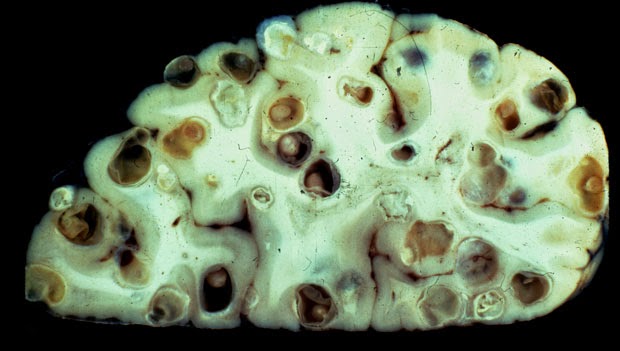
T. solium cysts in a human brain. Image from Discover Magazine.
 Obviously, having a 1-2 cm cyst calcifying in your brain will cause some damage. Neurocysticercosis is one of the leading causes of epilepsy in developing countries. It can also cause severe headaches, hydrocephaly and eosinophilic meningitis.

The National Institute of Allergy and Infectious Disease (NIAID) just released an article about the treatment-induced inflammatory response in pigs with neurocysticercosis. The current treatment of Praziquantel is apparently causing inflammation, blood vessel leakage, and damage to the blood-brain barrier. This means that new drugs need to be developed that can reduce inflammation at the site of the cyst(s) while maintaining the integrity and functionality of the blood-brain barrier and blood vessels.

Photo of the surface of the brain of a pig treated with the antiparasitic drug praziquantel showing blue-dyed (blue arrows) and clear (white arrows) cysts. The blue dye indicates disruptions in the blood-brain barrier. Image from NIAID/
Dr. Cristina Guerra-Giraldez.
This research only focuses on pig subjects, and has not yet been performed on humans infected with neurocysticercosis.


Want to avoid tapeworms and neurocysticercosis? The best way to do that is either to avoid eating meat, or to make sure your meat is cooked properly. Cooking meat properly is the best way to inactivate or kill most infectious diseases associated with meat consumption.

One of the major reasons diseases are so rampant in livestock is because a lot of treatments (mainly antibiotics) are used as prophylactics instead of at the onset of infection and symptom presentation. Animals that are raised in small, confined areas are more likely to be exposed to illnesses. When you are raising animals on a large scale and rely on them for income (whether through livestock trade, meat or dairy production), it can be really scary when one of your animals gets an infection, because you risk losing some of your income. It's obviously unethical to sell/trade sick animals, but it happens all the time, and is one of the main causes for the spread of disease to other regions. When prophylactic treatments are used, resistant infections are more likely to occur, which is an even larger problem (as I'm sure you can imagine).

Even if the meat you consume came from a healthy cow/pig/lamb/goat/chicken/turkey/etc., it might have been slaughtered in the same environment as a sick animal, which still puts you at risk. So, if you have a tendency to order your meat "rare", be sure you know the risks associated with that choice.

Edited to add:
I want to be clear that, even though I'm vegan, I believe choosing to be vegan is a very personal choice and no one should ever be bullied in to it. But, I also feel the need to add some information about the environmental impacts of eating meat to this post, since we are talking about risks associated with consuming meat. Considering the risks to yourself is very important, so you can actively minimize your risk of getting an infection or other serious health disparity (mostly through the long-term, excessive meat consumption),  but considering the long-term risks for the environment (ie- everyone on earth) is also really important. Here are some articles that you might want to consider reading before making a definitive decision about your dietary habits:

The Triple Whopper Environmental Impact of Global Meat Production: TIME

How does meat in the diet take an environmental toll?: Scientific American

Giving up beef will reduce carbon footprint more than cars, says expert: The Guardian

2500 gallons all wet?: EarthSave


Saturday, February 28, 2015

Toxoplasmosis

I was inspired to write this entry because I have a number of friends who have recently crossed over into that place in your life where you suddenly want tons of kids. Some of them have just recently birthed their first child (congrats to you), and some are just starting to feel that warm glow of constant nausea that will stick with them for the next few months. This is an awkward time for me, personally, because I fall into the category of "never, no, not interested" when it comes to babies. I've always kind of been that way, and yes, I fully acknowledge that my feelings could change in the future. I also want to point out that it would be fine if my feelings didn't change, because it's not an obligation that all women have (to have children, that is). I should also say that I like kids, and I think that they are amazing little creatures.

I wanted to bring this up for two reasons:
1. being pregnant has to do with the parasite I'm going to discuss later in this post, and
2. the Washington Post published an article about Eugenie Clark, who just passed away on Wednesday. The article is a great little summary of her life, but this is one of the most important parts (in my opinion):
"Professors at Columbia University told her it would be a waste of their time to admit her to their graduate program because she’d end up as a housewife..."
 Granted, this was in the 50s, but it struck me to see that so boldly stated. I've had mentors make comments like that to me within the last FIVE YEARS. While it's really important to state that women like Eugenie Clark have paved the way for women scientists, we still have a lot of work to do. I've had a lot of really incredible mentors, but it's hard to move past comments that one or two bad apples may have made, especially in such early and exploratory years of my career. If we strip away all the statistics about women and minority populations in science/STEM, we can still come to the same conclusion about comments that assumingly discourage someone from doing what they want to do with their lives: it's mean. It's really mean to do that to another human being, no matter what population they do or do not fit into.

I know that was more into my personal life that I usually divulge, but that article really inspired me.

So, back to my friends and their pregnancies!
A majority of my friends that are getting pregnant/having babies also have cats. I know, I know, you know where I'm going with this because its old news and everyone should already know about it. Well, not everyone does.

Toxoplasma gondii. Image from National Geographic.

Toxoplasma gondii is a parasite that can infect all warm-blooded animals and birds (as intermediate hosts), but is primarily centered around the definitive host: cats. Actually, over 200 mammalian species can act as an intermediate host for T. gondii, which makes the prevalence in humans pretty high.

As you can see below in this terrifyingly hilarious life cycle image (thanks, internet), the life cycle of T. gondii (sexual development) is completed in the intestines of a cat (even if it is a cross-eyed Halloween caricature of a cat like the one in this image).

Image discovered somewhere online, although I couldn't find a clear source which to give credit. Sorry.
Infection in humans is usually asymptomatic, meaning a non-infective (dormant, non-pathogenic) stage of T. gondii could be in you right now, and for most of your life without you even knowing! Most infections are triggered by a state of immunodeficiency. There have been some studies that have looked at the possible correlation between T. gondii infection and schizophrenia (a few years ago, you may have seen a bunch of sarcastic articles about how your cat is trying to control your mind, etc.). If you do develop acute Toxoplasmosis, you'll usually only experience non-specific symptoms, such as malaise, fever, and other flu-like symptoms that can resolve themselves within a few weeks or months. A lot of times, Toxoplasmosis isn't diagnosed correctly because proper diagnosis is really dependent on the organ system that is infected (heart, eyes, brain, etc.), and depends on the pathology lab to identify the organism in your tissue samples.

The biggest issue with Toxoplasmosis comes when you are pregnant, because it can cause spontaneous abortion, or if you carry to term, can be passed congenitally causing hydrocephaly, mental retardation, cerebral calcification, and chorioretinitis.

If you are pregnant and have an indoor/outdoor cat that uses a litter box in your house, I'd suggest avoiding any contact with it for the time being. You can be exposed to infectious fecal particles while emptying the litter box, that can be ingested accidentally. I'm not really sure why you wouldn't wash your hands thoroughly after handling an animals wastes, but that might be another thing you'd want to start doing, especially now that you are pregnant and all.

 Another fun thing about T. gondii is that you can become infected through organ transplantation! Organ recipients can get Toxoplasmosis from the new organ, or from self-activation (if you've already been infected with a dormant, non-pathogenic stage, but go into immunodeficiency after surgery). This is pretty rare, but it is possible.


Here's a picture of my cat, Milo (aka "Beef"), who usually helps me write these blog posts, and made it known that she does not appreciate this particular entry.

Wednesday, October 31, 2012

Eaten Alive!

-->Since it’s Halloween, let’s discuss the fact that you are being eaten alive, every second of every day.

It’s common knowledge that the average human body consists of more microorganisms than it does human cells, but no one ever talks about the symbiotic relationship that we’ve developed with each species that inhabits our tissues. Surely, when you think about bacteria and other microbes living on (or in!) you, your first thought is the microbes that live in your guts. But, this symbiotic relationship we’ve developed with other microbes extends much farther than your digestive tract. In fact, your human microbiome covers your entire body, from your skin to your inner digestive tract, in your mouth, on your scalp, everywhere!

Here’s a list of some of the most common human-inhabiting microbes that live amongst your tissues, day in and day out.

1. Demodex folliculorum


Demodex folliculorum is a type of parasitic mite that lives ON YOUR FACE. As we know with other species, mites love to have something on which to cling, so Demodex folliculorum will most likely be found around the hair follicles on your face. If you are thinking “but I wax my entire face!”, here’s a list of where Demodex folliculorum love to live:
  • nose hair
  • eyebrowns
  • eyelashes
  • the tiny hair that covers your entire face, but is most commonly on your cheeks and forehead (which my mom used to lovingly call “peach fuzz”).
 
Demodex folliculorum also like to live in your pores. They can be found on other parts of your body, too, but the face region is the most common. Now, don’t hurry to the nearest sink to wash your face. Demodex folliculorum are mostly harmless, and is classified as commensal, which means they benefit from consuming your dead skin and sebaceous gland tissue cells. Since Demodex folliculorum infestation is relatively common, they are considered a part of your normal skin fauna.

 
In the last 10 years or so, dermatologists have theorized that a heavy infestation of Demodex folliculorum may be the cause of rosacea in later years in life. 


2. Spirochaetes spp.
I can’t tell you how many times I’ve heard someone say “…but a dog’s mouth is supposedly really clean!” as a dog licks their face. First off, did you know that dogs consider cat feces a delicacy? Secondly, I’d love to believe that dogs have some secret antimicrobial property that allows them to cure all ailments, but let’s be realistic. We know that magical property only exists in unicorns.


Mouths are pretty disgusting places, regardless of what species you are. For humans with periodontal diseases (such as gingivitis or other oral inflammatory infections), Spirochaetes spp. are levels are elevated. 

 
The Spirochaetes spp. belong to a bacterial phylum that have double membranes (diderm). They are most commonly long coils, and live in those hard-to-reach areas of your mouth. To reproduce, they undergo asexual transverse binary fission, producing two identical cells.


If you have good oral hygiene practices, then you should have nothing to worry about with Spirochaetes spp. They will be found in your mouth no matter what. The only time Spirochaetes spp. can become a problem is if you have periodontal diseases, which can lead to an active infection.


3. Candida albicans
Candida albicans is a common species of yeast that lives in and on your body. You depend on Candida albicans for digestion, as it exists as a part of our normal gut flora.  Yet, sometimes overgrowth can occur, causing candidiasis. 


Candidiasis can rear its ugly head in many anatomical locations. We most commonly hear about yeast infections affecting the female reproductive system, but yeast can inhabit your body in many different areas. 


Yeasts like to live in warm moist areas, so oral tissues are another common location to see a yeast infection. Extreme cases can cause thrush on the tongue. Candidaisis can also occur in your ocular tissues (eyes), and occasionally on the skin. 


I'm keeping this post short because it's my favorite day of the whole year. Halloween is a great time for scientists because we get to put our creative nature into costumes!  If this post wasn't scary enough for you, feel free to check out my post from last Halloween

Happy Halloween!

Tuesday, February 7, 2012

Hearts A'flutter with Infection

I admit, I'm a total sucker for Valentine's Day. I'm pretty sure this has something to do with my childhood, since my mother's favorite holiday is Valentine's Day. She made it her mission to make Valentine's Day as big as Easter, right down to getting festive baskets full of heart-shaped candies and whatnot.

What I also love about it is the imagery. It's the one day of the year when mainstream culture romantically fetishizes an internal organ! How sexy is that?


Did you know that in one day, the force of your heart pumping causes your blood to travel approximately 12,000 miles? That's four times the distance across the United States, from one coast to the other.

The heart is an amazing organ. It's, quite literally, the lifeblood of your existence, pumping nutrients and oxygen to every bit of your body, working with the lymphatic system to circulate immune system cells, keeping you alert. But the heart is also a vulnerable place. Although we mostly hear about parasites of the GI tract, there are many other organisms that see our circulatory system as an all-you-can-eat buffet.

If you think about it, the circulatory system and heart provide the perfect environment: tons of nutrients (see: snacks), tons of oxygen, a comfortable temperature (like a sauna full of blood) and hardly any competition.Who wouldn't like that?

Since this is a post for Valentine's Day, I'd like to tell you about the best of the best. Please keep in mind that there are thousands of things that can find their way to your heart and eat you inside out. These are just some of the highlights.

Protozoan parasites:
Leishmaniasis is typically seen to affect the spleen, liver and bone marrow during a visceral infection (as opposed to the cutaneous infection that causes lesions and boils), but it can also find it's way to your heart and cause damage there. There are about 500,000 new cases of visceral leishmaniasis every year, but they are all dependent on the local sand fly population, which acts as the vector for the disease.


Visceral leishmaniasis results in the inflammation of the infected organs. If not treated, the swollen organs may become non-functioning, which can result in organ failure and death.


T. cruzi, the cause of Chagas Disease, has shown high cardiotropism that is unmatched by other parasitic organisms. This flaggelated protozoa has the ability to "swim" or move throughout your system.

Not a sea slug, but just as cute?
Once settled in a comfortable area (filling the void of your broken heart), your heart will begin to swell with the inflammatory response. After trying to kill off the invading organisms, cellular damage and fibrosis occurs, making the likelihood of heart failure very high.

This is your heart on Chagas Disease.


Worms and things:
Schistosomiasis, also known as Snail Fever, is a parasitic worm that causes a chronic condition in adults, and impairs cognitive development in children. Early stages of Schistosoma development, the immature worm feeds on red blood cells. While it mostly affects the liver, the worms occasionally can get turned around and burrow into the heart tissue. Schistosomiasis has a very low mortality rate, but is very devastating. 

D. immitis is the very well known "Heartworm". We mostly hear about heartworms in our pets, but they can definitely infest humans, albeit rarely. The heartworm doesn't become an adult until it has settled into the pulmonary artery. Before that, it's transmitted from host to host by it's vector, the mosquito.

Dog heart.

Echinococcosis happens to be one of my most favorite parasites. Echinococcosis infects mostly mammals, including humans, and is transmitted directly through the accidental consumption of a cyst or egg form. While mostly found in the liver, up to 25% of cases are found in organs like the heart, brain, kidneys and less commonly, lungs. But this worm is special. Echinococcosis is also known as hydatid disease, from the formation of hydatid cysts.

Hydatid cyst, single and ready to mingle.

The worm develops it's eggs into a collection of "egg sacs" or bubbles within a tissue. These sacs have multiple compartments of eggs, and have the ability to grow very large and very numerous. They are strong enough to survive the host's environment, but delicate enough to be very tricky to remove during surgery. If a cyst bursts, the patient can go into anaphylactic shock (similar to an appendix bursting).


On a sappy note, I started this blog almost 2 years ago because I needed an outlet. I was talking too much about the dangers of the world. My friends and family were tired of hearing about my research or the latest in disgusting discoveries (and still, my dad seems to be the biggest fan of my blog!). Even worse, I was ruining dates! You can always tell how the rest of the date is going to go when you mention that you may have been handling active HIV earlier that day in your lab, or you have volunteered your time to look at poop samples from the county. My favorite was the date that said, "I mean, I like nerdy girls, but I kinda just meant girls in glasses."

As of now, I'm miles ahead of where I was 2 years ago, both in my career and my life in general. To be honest, I never really thought that my life would involve any sort of writing, other than the to-the-point articles of my great discoveries in science (I say, as if I'm Marie Curie or Barbara McClintock). What I'm trying to get at with this uninteresting rant is THANK YOU, dear readers, for taking an interest in my low-bar jokes and nasty photos. I hope this blog has, and will continue to, help you as much as it has helped me.

Happy Valentine's Day!

Monday, October 31, 2011

Ghosts, Goblins & Things That Will Actually Kill You

I love Halloween, which is why I'm sitting at home alone, wearing my festive ghost-print pajama pants, tea in hand, writing this blog entry. As I sit here, eating my unfestive leftovers and unexciting salad, I'm laughing to myself. NPR is posting ghost stories, Buzzfeed posted "10 creepy photos from Halloweens Past", and articles like "13 Real Animals Lifted Directly Out of Your Nightmares" [cracked.com] are actively being read.

So, I'm giggling to myself, pushing my food around in the bowl thinking, "how can I write a blog entry about things that are already halloween-esque?" This is a challenge for me, because I am not a fan of horror films. I know, you'd think someone who dedicates their life to viruses, parasites, and other creepy crawlies would be excited by the thought of paying $12 to go watch two hours of ghouls and scantily-clad ladies screaming... but I'm not.

Then I found this list of the 10 Scariest Horror Movie Characters (also on Buzzfeed, which is oddly addicting if you avoid all the celebrity gossip and pseudo health advice). While I have only seen one of these movies, I think I can match all of these horror movie characters with real horror. So here we go...

1. Exorcist Girl? Ebola


Sure, I haven't seen this movie, but I can recognize all the references from pea soup to spinning heads. There are parasites that take over their hosts' brain functions, but that's mostly seen in smaller animal models or with prion diseases (which are not parasites). Want to read about Ebola? Check out one of my past entry here.


2. Leatherface?  Leprosy.


 Leprosy is a really unfortunate infection that is fortunately curable when discovered early. Read up on it here.


3. Creepy Girl from Quarantine?  Hookworms.


Nothing says sexy like gnashing teeth.


4. Jason Vorheese?  Primary Amoebic Meningoencephalitis


Both Jason and Primary Amoebic Meningoencephalitis are found lurking in lakes and pools of water, and both will make you crazy. 


5. Old Man from The Unborn? Hobo Spiders.

My partner called my attention to these baby hand-sized wonders. Apparently, he used to wake up to them crawling on his chest, and the males also are very territorial and will charge at you and chase you around a room.


6. Pennywise from It the Clown? Tapeworm.


Both Pennywise the Clown and tapeworms lives amongst poop and eat your insides. The similarities are uncanny! Read about fun tapeworms here!


7. Freddy Kruger?  Bedbugs.


 ...because they get you in your sleep! Here's an older post about bedbugs that will make you want to sleep with one eye open.


8. The Girl from the Ring? Onchocerciasis.


 Onchocerciasis is the clinical term for "River Blindness", which is a disease caused by an infectious roundworm. This one is a bit of a stretch, I know, but that girl has creepy eyes.


9. Michael Meyers?  MRSA.

One of the latest things in medical news is drug resistance. Much like Michael Meyers, MRSA just wont die!


10. Old lady from Legion? 


Three Words: Ellen Albertini Dow


Happy Halloween!