Showing posts with label Immunity. Show all posts

Sunday, January 25, 2015

A two'fer

January: the peak of flu season, the aftermath of the holidays, and my birthday month. To celebrate all of those things, you get a two'fer today. Two subjects, one post.

Before I dive in to my two topics for today, I wanted to remind you that the Ebola outbreak is, unfortunately, still going strong. Just because the news no longer finds it new, doesn't mean it's over. Just because someone made "Ebola patient" Halloween costumes and oh, Halloween was so long ago, doesn't mean it's over (also, you should be ashamed of yourself if you donned that, or any version of that costume). As of yesterday, the outbreak has killed more than 8,600 people. I encourage you to stay informed via the Ebola Map.

Anyway...back to our regularly scheduled program:

Let's play GUESS THE DISEASE!

In 1757, a Scottish physician by the name of Francis Home proved that ___________ was caused by an infectious agent in the blood of afflicted patients.

In 1912, __________ became a "nationally notifiable" disease in the US, meaning that all health care workers were required to report all cases, as approximately 6,000 deaths were caused by _________ per year.

In the 1950s, nearly all children got __________ by the time they were fifteen years of age, causing scientists and the federal government scrambling to find a solution. In 1963, a vaccine was finally available. Thanks to the development and approval of the vaccine, the US government aimed to eradicate _________  by 1982. While this didn't completely happen, cases were decreased by 80% from 1980 to 1981.

In 2000, _________ was declared eliminated in the US.

Have you figured it out yet? Better yet, have you caught it, yet? (haha I'm so funny)

Still stumped? Here's one last hint:

Photo courtesy of the Centers for Disease Control and Prevention
It's Measles! The famous Morbillivirus is back in a big way, and is running rampant at one of the happiest places on earth. Measles (or Rubeola) is a highly contagious negative-sense single strand RNA virus of the paramyxoviridae family that is illustrated by symptoms in the respiratory tract, skin, and immune system. The obvious rash (seen above) is often accompanied by a hacking cough, Koplik's spots, red eyes, and high fever. Measles is an airborne virus and is dependent on aerosolization (coughing, sneezing) in order to spread properly. The virus can "live" in aerosolized droplets for up to two hours on a surface. Assuming there are no complications, measles usually runs its course in about 7 to 10 days (like a gross case of the flu).

So, why do we care? Why was the US government in a rush to eradicate such a disease?

Measles is really prominent in children, and children usually don't have an immune system that can withstand stubborn viruses with a history. A lot of children (actually one out of every 20 kids infected) end up developing pneumonia as a result of a measles infection, which is actually the leading cause of death from measles in young children. About one out of every 1,000 children that are exposed to measles can develop encephalitis, which can cause permanent brain damage due to excess swelling. Ear infections associated with measles (affecting 10% of infected kids) can result in permanent hearing loss.

It's estimated that over 16 million people visit Disneyland every year, with attendance fluctuations based on holidays and common school schedules (like summer break). That's almost 45,000 people PER DAY in a place were everyone is touching everything from handrails to harnesses, from interactive displays to the bric-a-brac in all of the shops.

In the latest measles outbreak, that officials are saying started at Disneyland, a handful of employees were also infected. I bet a lot of those employees were vaccinated as children, but since Disney hires people from around the world (I say this as a fact that I applaud because everyone should be able to live out their dream of working at Disneyland... and because I desperately want to be Maleficent), I bet a good chunk of their employees didn't grow up in areas that enforce strict vaccination requirements for school-aged kids. Vaccination requirements vary by state, by country, and some are better enforced than others. Plus, school-based vaccination requirements don't usually include home-schooled kids.

I'm not going to launch into some diatribe on how I feel about vaccinations (I'm sure you know already if you read my blog regularly), but I will say that the MMR vaccine (that's Measles, Mumps, and Rubella in a combination vaccine) has lead to a 99% reduction in infections, compared to the pre-vaccine era (prior to 1963). If you aren't sure about your vaccine history, I heavily encourage you to go get an Antibody Titer Test done. A titer will tell you what antibodies you have the ability to produce, whether from vaccines or direct exposure, and will tell you which ones your body isn't able to currently make, meaning you haven't been exposed, or you need an additional vaccination or booster. Not only could this simple test save your life, but it could also save the lives of others that may not be able to fight off diseases. If you're vaccinated, it's like saying "Hey disease! You'll have to get through me first before you can infect this baby, that old lady, or that person with a compromised immune system. OH WAIT, YOU CAN'T!"...and suddenly you're a hero.


I also want to remind you that its not just Disneyland, and its not just measles. Think about how many people you encounter every day, and how many people your family members encounter. Who knows what you've touched! I take the bus every day to work, and I can't tell if it's making my immune system stronger, or taking years off of my life.


Speaking of taking the bus, here's your second subject!!

I've been reading a lot since I've started taking the bus to work. I mean, reading for fun. This is the first time in probably 20 years that I've really had time to read for fun, to read for ME, and I love it. In fact, I've already finished my first book of the year, and while it wasn't science-related, there were some topics that really interested me.

The book I just recently finished (because I seriously couldn't put it down) was Unbroken by Laura Hillenbrand, which details the life of Louis Zamperini and his experiences during World War II. It is heartbreaking and amazing. I cried multiple times on the bus while reading this book (what, Zamperini reminded me a lot of my late grandfather, so it was extra emotional for me).

I won't spoil the book, but there are a number of chapters that talk about the life of American and Allied men that were caught and held as POWs in Japan. One of the most prominent health issues that was seen in these camps was beriberi. Beriberi is an illness that occurs as a result of severe thiamine (vitamin B1) deficiency, without infectious agent, and presents in two ways: wet beriberi and dry beriberi.

Wet beriberi affects the cardiovascular system, causing shortness of breath, increased heart rate, and swelling of lower extremities. Dry beriberi, or Wernicke-Korsakoff syndrome, affects the nervous system, and can cause loss of feeling, paralysis, difficulty walking, mental confusion, strange eye movements, pain and vomiting. Both wet and dry beriberi can become severe very quickly, and can lead to permanent damage and death.

Thiamine deficiency is common in developing countries, especially regions with restricted access to food due to war, severe economic conditions, and environmental conditions that make it difficult to grow or access food. I bring this up because it's easy to read a book like Unbroken, and think about beriberi as an issue that only hurt POWs during WWII, because you stop hearing about it once you finish the book. I encourage you, as you read books or whatever you're looking a online, to do further research and teach yourself something new. LeVar Burton would be proud of you.

Saturday, January 14, 2012

Common scientific myths that are regularly exploited by mass media

I'm a gmail user, and I have my iGoogle news widget set to show me all the "health" related news (if you've seen this setting, then you understand why I use parentheses with the word health). There is always at least one laughable article each day. While this is funny, it's also really scary.

I mean, around the time of the listeria outbreak in cantaloupe, there were 1,600 articles a day that clearly stated "OMG DON'T EVER EAT CANTALOUPE EVER AGAIN!" Was that necessarily helpful? Is that considered informed reporting? Not everyone wants to read scientific articles for accurate information. I mean, I don't even want to read them (that was a lie). Scientific writing is different. It's blunt and bland, lacking any decoration. But, it's also very important.

So, on Friday, I sat down at my desk at work and opened up my browser to see a particular article that lit a fire under my butt faster than a bunsen burner attached to a leaky gas valve (insert fart joke here). Everything about it was wrong, and it scared me! So, I decided to round up a few myths about recently popular science topics.

Myth #1: Just about everything you've ever heard about HIV or AIDS from mainstream media.
If you know anything about me, you'll know that this is my biggest pet peeve (well, that and chewing with your mouth open, but I digress). Since the beginning of the HIV/AIDS epidemic in the 1980s, mainstream media has disregarded scientific progress and facts when reporting on the matter. We've heard everything from "AIDS is a gay disease" to "the government created HIV to scare the American public into submission", and every idiot thing you can think of to fit in between. My favorite is "HIV isn't real".

...oh, right. Why don't you tell that to the 43,000 people, in the United States alone, that were diagnosed with new HIV infections in 2009.

The article that actually inspired this blog entry ['HIV was invented as the cause of AIDS to get research money' claims radio host] can pretty much be summed up in this video. Need I comment on this?

Last year, news of a research breakthrough exploded all over the world. "Finally! Scientists have cured a man of AIDS!" It was everywhere, but it's not exactly...oh, what's the word I'm searching for...reasonable? Yeah, that's it! Bone marrow transplants are difficult and expensive. You must have a very specifically matched donor to avoid any complications (ie- rejections or immune responses to the foreign matter).

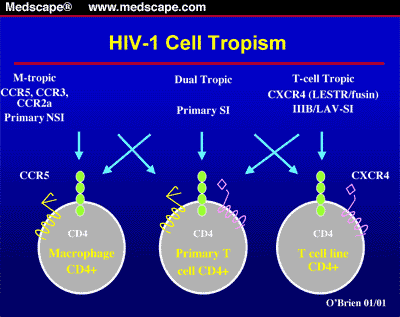
The concept behind the bone marrow transplant was based on the delta32 mutation. Discovered in 2005, the delta32 mutation allows a fraction of the population of Europe to show signs of immunity towards HIV-1 infection, but not all types of HIV-1 infection. Viral tropism allows for different strains, or variants, of the virus to use different co-receptors that are naturally expressed on the host's cells, primarily T-cells. CCR5 and CXCR4 are the two co-receptors that are primarily used for access to the host cell. These co-receptors are also used to elicit a cell-mediated immune response. Due to viral tropism, different strains utilize different co-receptors for viral entry into the host cell. That is, HIV-1 strains that use CXCR4 don't necessarily need CCR5 co-receptors for entry. Therefore, individuals who have the delta32 mutation are not 100% immune.


People are all too quick to jump on the opportunity to say "We've done it! We've cured AIDS!" We saw this in the dawn of medicinal cocktails, and we'll see it again. But, the magnitude of this disease is so great, that the types of breakthroughs we are making right now are not satisfactory enough. We cannot feasibly give every HIV-positive person a bone marrow transplant, but we can turn to the micro-science behind the theory of why this works. We can't look at HIV medication, because they are expensive, extensive and not available to everyone, but we can look at making more affordable and readily available drugs. It's one thing to be blanketly hopeful; it's another to be realistic.

Myth #2: Food poisoning is limited to meat products.
This is an easy one. The probability of getting a food-borne illness does increased when livestock involved (POOP, EVERYWHERE!), but also has to do with the fact that most people don't effectively cook their meat. Let's face it, there is poop covering everything on this planet, whether it's from humans, animals, or insects. That is why we have immune systems.

This is something I hear a lot from people, because I'm vegan. "Have you read Fast Food Nation? Did it scare you into your dietary choices?" Just stop it. It's not about any book or any food-borne pathogen. We've gotten to the point to where our food is so mass-produced and unproportionally regulated that we are bound to run into problems, no matter what we choose to put in our mouths.

Interestingly enough, wikipedia has a very extensive list of food-borne illnesses, listed chronologically by year. Some of the deadliest, actually have been in cantaloupe, peanuts, spinach, bean sprouts, green onions and apple juice. By all means, take this into account, but don't let it scare you away from the ever important "green group" on the food pyramid (or plate, or whatever you want to go by).  Take actions into your own hands, and look at where you are getting your food from, and how you are preparing it. I've already written about the horrors of food (and feel free to refresh your memory!), and I'll probably do it again.


Myth #3: Immunizations will give your child autism.
Oh, Jenny McCarthy, you gorgeous idiot. I thought this issue was left behind with the early 2000's, but apparently I was wrong.

According to facebook, everyone I know is pregnant right now, and everyone is posting about issues like "is breastfeeding wrong?" or "does Baby Einstein really work?" Sure, whatever. I'm all for people trying to decide what is best for their child, and using whatever resources are available to them to do so. But, one of my friends started posting videos (this one in particular) about the horrors of vaccines, and stated that she was trying to decide what to do for her newborn (while logically consulting youtube).


Instead, why don't you start with the CDC's take on Vaccines and Autism. A scientific review by the Institute of Medicine (IOM) concluded that "the evidence favors rejection of a causal relationship between thimerosal-containing vaccines an autism." The CDC supports the IOM conclusion. Also, here is an article from 2007, titled Vaccines and Autism, by Dr. Brown, that talks about immunizations from a medical perspective. Both the medical and scientific communities reject Jenny McCarthy's claims that vaccines cause autism.

Nevermind that the first vaccination demonstration in 1798 would lead to the eradication of smallpox in 1980. Or more recently, nevermind the fact that polio has almost been eradicated in India due to vaccinations. Oh, I get it, you're worried about what vaccines will put in your child's body, but you'll feed them McDonalds. That makes sense.

I understand they hysteria of wanting to do what's best for your child, but I will never understand taking medical advice from a model (oh wait...she was "Playmate of the Year" in the 90's, so that's like getting a doctorate, right?), or from youtube.

Let's talk about health the health of children around the world.


There are plenty of other myths out there that I'd be happy to discuss. Just send me an email with your requests.

Also, my belated apology for not writing more frequently. I've been working very hard lately to get two grants, and things are starting to pay off (literally and figuratively!). 

Monday, April 19, 2010

Secret Benefits of Thalassemia

I didn’t think it would happen, but I actually had a request for my next blog entry!

I can’t exactly tie this one into any overly religious, candy-laden holiday, but it happens to be one of my more favored parasites that are often mistaken for a virus… any guesses?


Malaria!

I’m not sure why, but I’ve heard many people refer to malaria as a viral infection, when it is actually a hemolytic parasite. Maybe it’s the fact that early malaria was associated with the air content of the prevalent environments (often murky or musty), which gave rise to the naming of malaria-- meaning “bad air”. This can be drawn to some viruses and their airborne, or aerosolized, transmission technique. Yet, we (as in…scientists, duh.) quickly discovered that malarial transmission was not through aerosolization of a virus, or from any direct contact. The only other similarity that the parasite genus Plasmodium has to common viral infections is the series of flu-like symptoms, such as fever and chills. In initial diagnosis trials, malaria was often misdiagnosed as an ongoing influenza with rhythmic symptom cycles. Seasonal influenza causes anywhere between 250,000 and 500,000 deaths annually, whereas Malaria causes approximately 1 million deaths annually. Needless to say, there are major differences.

So, now that we know Malaria is, in fact, a parasite, the details of its lifecycle can help answer many further questions (also, one specifically that has been requested).

Malaria is actually, roughly, an umbrella term that can be used to describe the disease in humans that is caused by four parasites: Plasmodium vivax, Plasmodium falciparum, Plasmodium malariae and Plasmodium ovale.

Plasmodium ovale is regionally specific to West/sub-Saharan Africa, with a much lower prevalence (~5%) in places like the Philippines, Papua New Guinea and Cambodia. P. ovale is very specific in region and may seem to have a stippled appearance. P. ovale is also the only form of malaria that is fibronated.

Plasmodium ovale: trophozoite after "ring stage"

Plasmodium vivax is the most common form of malaria that causes reoccurring symptoms, or is tertiant in its cycle. P. vivax is found widely spread over Asia, Latin America and some parts of African, and causes debilitating, reoccurring symptoms that are mostly non-fatal. It can also cause splenomegaly, or enlargement of the spleen, which is highly fatal.

Plasmodium vivax: immature schizonts in human blood smear

Plasmodium malariae is very similar to P. ovale, in that it causes “milder”, or less fatal symptoms in very specific areas. P. malariae is thought to be the oldest form of Malaria causing parasites, and is relatively non-commensal. P. malariae undergoes a quartant cycle, replicating every 72 hours. Sometimes, the meroxoites form in a rosette fashion. My parasitology professor always used to say “if you have to choose which type of malaria to be infected with, choose Plasmodium malariae.”

…right. It’s so convenient how those Anopheles are giving you a choice, these days.

 Plasmodium malariae: trophozoite illustrating the "ring stage" in human blood smear

Now, my favorite, Plasmodium falciparum is the most deadly of the four. To illustrate its fatal nature, it is shaped like a banana. Yea, a deadly banana. Aren’t you scared?

P. falciparum is often termed as the “newest” of the four because it is so dangerous and deadly. In recent years, it has accounted for more than 95% of all malarial infections, and over 90% of all the deaths caused by malarial infections. P. falciparum has the unique ability to infect one cell with multiple merozoites. Essentially, P. falciparum is like a sniper version of malaria: it gets the job done. Like I said, deadly banana.


Plasmodium falciparum: banana shaped gametocytes in human blood smear

The lifecycle of malaria occurs in two parts: the sexual cycle that occurs within the vector’s gut, and the asexual cycle that occurs within the human host’s tissues and circulatory system.

Within the human, the Plasmodium sporozoites infect the liver cells and release merozoites. These merozoites infect red blood cells, replicate, and cause the red blood cells to literally rupture and explode in order to infect other red blood cells nearby. Eventually, this causes chaos in your liver tissues and circulatory system. 

Credit: NIAID

Yet, interestingly enough, if you already have Thalassemia, you have the added bonus of an evolutionary “immunity” to malaria diseases. Thalassemia is a disease associated with globin gene mutations (both α- and β-globin genes can be mutated, yet α-globin mutations are most common). Since your α- or β-globin gene is recessively mutated if you have active Thalassemia, your red blood cells develop into malformed, or sickled, cells, thus inhibiting their affinity to bind and transport oxygen. This lower affinity can cause extreme cases of anemia. In major cases, treatments such as chronic blood transfusion therapy, splenectomy, transplantation and iron supplementation are used.

Many immunologists believe that this immunity to malaria diseases that is associated with Thalassemia is a result of Darwinian genetics. A good example of this is Africa, which has some of the highest rates of malaria in the world, as well as a Thalassemia diagnosis of approximately 40% of the entire population. Those with the recessive mutation survive malaria more effectively, and have a higher likelihood of handing such mutations down through to following generations.

On a semi-related note, a friend turned me on to this Animal Planet show called Monsters Inside Me, which is all about parasites and other fun things! Here is a short video about malaria with some neat animations of the active infection:


I’m sure I will go into more specifics about malaria in future posts, but I wanted to address the question and request that I received in a timely manner. With that being said, if you have a topic that you are dying to read about, please feel free to send me an email, and I’ll get to it!