I'm sure I don't need to start this by saying I haven't been purposefully neglecting this blog, I really am rather busy. Truly, honestly. But, since I feel so badly about not writing as regularly as I had hoped 3 months ago, I'll make it up by writing about one of my favorite subjects to talk about on a first (and usually last) date.
When you say "fly" to the average person, they usually think about the common house fly, or possibly a unicorn soaring elegantly over a pastel rainbow. Yet, when I think of flies, the first thing that pops into my head is the Botfly. Why? Because its disgusting and amazing.
Botflies are particularly special, because their larvae live as parasites during their development and maturation process. Why would you want to mature in the vast world of exposed nature when you have the opportunity to embed in the flesh of another living species?
Let's break down the amazing lifecycle of the botfly, because its rather unheard of for flies to deposit their eggs anywhere other than...well, you generally only hear of maggots and fly eggs/larvae around garbage cans and dead things, right? These flies are bold, and think that their larvae deserve a better environment than a trashcan. The female botfly, a large and dominating specimen, carries the eggs. She waits until she sees a suitable intermediate vector flying around a suitable host, such as a tick near a grazing animal or a mosquito that is preparing to feast on a human. Once the female botfly has chosen her target, she tackles the insect mid-flight. They begin to fall and roll, and as this happens, the female botfly deposits her eggs onto the intermediate vector and flies away.
I know, this sounds weird, and it definitely is, but the botfly species is smart for doing this. Most species recognize the large botfly as a threat, and will avoid any contact. Yet, if the eggs are disguised on another, much smaller species, then everyone wins!
So now, we've got the intermediate vector covered in eggs. It regains flight and goes after its bloodmeal (although, not all intermediate vectors for the botfly consume blood). When the intermediate vector lands on the mammalian host, the eggs are attracted to the heat, causing them to drop and land on the flesh of their new host. The intermediate vector takes a meal close to the location of the eggs, and they burrow towards the new opening in the flesh.
Once inside, they make their way to a comfortable area under the skin and develop for approximately 8 weeks. They survive subcutaneously by breathing through small tubes in their butt that open at the surface of the skin. These are visible, and will bubble if held underwater.
When the larvae is ready to emerge as a pupae and continue developing in the wild, it will burst from the flesh of it's host. If you can stomach it, here is a video:
Botfly larvae have a distinct "hook" mechanism that allows them to attach to the layers of the skin and avoid being pulled out. If you have a botfly infestation, they must be removed with minor surgery or suffocated before removal. You can see the hooks in these photos, they are clearly visible as the darker spots that form rings around the body.
And here is an awesome photo of a dead (suffocated) botfly larvae being removed from someone's head:
Botflies can be a large issue for small farms raising animals, and for stables holding horses. Also, if the wound is licked, possibly by the animal itself (we've all seen dogs lick their wounds), then the larvae can burrow in the intestinal tract and cause severe infections.
There are many different species of botflies, and they are found all over the world, including in the United States. Now that the weather is going to start warming, you can think of this every time you leave the house!
Happy Spring!
Friday, March 4, 2011
Sunday, February 20, 2011
Contest Winner!
As you may recall from the last entry, I received an email from a reader in the UK that was convinced she had discovered a tapeworm in her kitchen sink. After looking at the photos, I scripted an email to her, and then opened it up to the vast community of internet-based intellectuals. Contests ensued.
I got more entries than I had anticipated, but, actually, the first guess I had came only minutes after I had posted the initial photos and contest info.
So, congratulations to Jen S. from Oakland, CA!
If you were curious, here is the answer and the reasons I detailed for my decision:
Problem solved. Thanks, scientific reasoning!
Also, big thanks to everyone who entered their guesses.
I got more entries than I had anticipated, but, actually, the first guess I had came only minutes after I had posted the initial photos and contest info.
So, congratulations to Jen S. from Oakland, CA!
If you were curious, here is the answer and the reasons I detailed for my decision:
To be honest, it doesn't really look like a tapeworm, and there are a few reasons for this:
- Tapeworms are usually classified by the different shapes their "head" (more appropriately, scolex) because they use various hooks and suckers to attach to the gut wall. If you look at your worm's ends, there isn't a distinct sucker or any sort of texture that would indicate hooks.
- Tapeworms segments are all little sacks of eggs and/or reproductive organs, depending on the species. They mature as they move away from the scolex, further down the worm. They get larger and more defined as they move down, too. This worm seems to have regularly sized segments all the way down.
- The middle section that is a different color, see that? That resembles what most annelid groundworms have, called a "clitellum". Its usually much lighter in color, but that's the only thing I can think to compare it to.
- If this were a parasitic worm, it would not be a tapeworm, because they are generally flat, especially towards the ends that can break off. Most parasitic nematodes that take on the roundworm shape are not segmented, and most of them are too small to take up a large segment of a plate.
I think its safe to say that it is an Eisenia fetida, or a "Red Wriggler". They are used in composting (do you or your neighbors compost?), and can live in environments that are unnatural for most worms. They are found all over the UK. I think you, and your cats' backsides, will be totally fine.
- Since you did put it in water, and it wriggled around, it was probably doing its best to get towards some air. Have you noticed that groundworms and snails like to come out during the rain? That's usually because the ground absorbs too much water. Their tunnels and burrows in the ground fill up, and they don't have access to the appropriate balance of oxygen and moist environments.
Problem solved. Thanks, scientific reasoning!
Also, big thanks to everyone who entered their guesses.
Wednesday, January 19, 2011
Anonymous Worms Contest
I've received some rather interesting emails lately, now that the blog is starting to circulate a bit more (how that's happening, I'm not really sure!)
Before I tell you about the best email I've received yet, I'd like to briefly mention that I've won a "featured blog" award for a rather random site and received a rather awesome Follow Friday shout out on twitter from Nikon Small World Photography Competition. Weee!
This morning, however, I realized I had been neglecting my microscopic.blog@gmail.com account. Waiting for me, patiently, was an email from reader Denna from the UK. She writes:
Before I tell you about the best email I've received yet, I'd like to briefly mention that I've won a "featured blog" award for a rather random site and received a rather awesome Follow Friday shout out on twitter from Nikon Small World Photography Competition. Weee!
This morning, however, I realized I had been neglecting my microscopic.blog@gmail.com account. Waiting for me, patiently, was an email from reader Denna from the UK. She writes:
Ok, I know I should let this go. Forget about it. But I can't; I am totally grossed out by what was in my sink this morning (attached).
I assume it's some kinda tapeworm? But where the fricking hell did it come from? I keep a very clean kitchen. In fact there are those who think I'm obsessive compulsive about keeping the kitchen clean. I am a rigorous vegetarian and an almost vegan (no milk no cheese) and have been for twenty years. The only meat that ever enters my flat is in cat food tins, and I only buy one brand...
Denna details her morning about eating coffee and toast, and later going back for some oatmeal. As someone who can eat oatmeal for days on end, I like this girl already! Additionally, she's a borderline vegan who knows that its cruel to force house cats to acclimate to a vegetarian diet, as their species requires meat for survival. +100 points for Denna! She continues...
I placed the oatmeal pan in the sink to fill it with water and that's when I saw the tapeworm. There was water in the metal lipped dish from when I rinsed the cat food tin. I was gobsmacked. And I felt seriously sick imagining where it came from. The only place I can figure is the cat food tin. It was a newly opened tin - I popped the ring pull this morning - could a tapeworm survive in an anaerobic tin of food? I guess it could since they live inside animals. Ugh!! But wouldn't factory processing kill it? I kept the little bastard on my windowsill all day in the dish just to convince myself it was indeed a parasite. It must be - it didn't drown it just kept swimming round like some freaking miniature Loch Ness monster. There was a tiny bit of cat food in the dish and it knotted its lower half around the food while its head snorkelled around. Christ, honestly it was worse than imagining what was in that Maryland forest in the Blair Witch Project. Totally totally repellant.
A few years ago, I camped in that same forest in Maryland where the Blair Witch Project was filmed -- no joke. It was very beautiful, and I'm sad to report that there were no witches, or tapeworms, to be found.
Wrong type of worm, Denna. Tapeworms don't usually enter the anus... That would be characteristic of a pinworm, which exits its host's anus each evening to lay eggs on the perianal tissue (skin between the anus and genitals). But either way, its a fun image, right?! This is definitely not a pinworm...so what is it!?Finally around 5pm I picked the dish up and hurled the contents against the garden wall. The little bastard is probably out there now negotiating his way back into the kitchen. Or worse, he's waiting for one of my cats to go out there so he can crawl up their backside and introduce himself and his billion offspring into my flat.
So you're the expert - can you tell me what this is and how it might have got in my sink?! BTW, it was about 3 1/4 inches long. And red. And horrible, disgusting and gross. And I am never eating out of that yellow dish again. Seriously.
Dena said the magic words: "You're the expert". Heart a'flutter! I'm sure she wont like it when I mock her fear of eating off of the yellow dish by posting this video of Bear Grylls eating a giant larvae (beware, not for the weak-stomached or the faint-hearted).
That man will put anything in his mouth, and drinks his own urine like its gatorade.
So why don't we play a little game? I've already responded to Denna Dearest, but I'm going to post the photos, and YOU see if you can identify who Denna's special friend is.
The first person to get it right will get a super awesome & artsy/science-y prize!
Email your guesses to microscopic.blog@gmail.com and I'll announce the winner in my next entry!
Saturday, January 1, 2011
A New Year for you, and for Science
Happy New Year to all my dedicated readers, albeit the few and far between!
New Year's is always a time that I take to reflect on the past year, and search for room for improvement for the next year. A closing of one door, and a window of opportunity for the up and coming. Sure, this sounds wonderfully personal, but it can be applied to anything. I'm sure you can guess that I do take a moment (or many!) to reflect on the scientific advances for the past year. There have been some amazing discoveries that, by reflecting on them, can give us hope for the future.
2010 was a hefty year for health, science and infectious disease, but most of these achievements aren't taken with the weight that they should, because there is still so much to be done.
NASA discovers microorganisms that survive on arsenic:
NASA can discover a form of life that exists on arsenic, and while most people think "that's cool" or "ok, so? I don't survive on arsenic so how does this involve me?" they are failing to realize that this is challenging the theories that we've trusted since the early developments in cell biology. How does that affect medical based sciences, you ask?
Aside from the fact that everything we know to exist is based on our knowledge of cell biology and atomic structures, so are most of the things that infect us, harm us and battle our immune systems. Now, no, don't jump to conclusions and say "OMG, I'm being infected with cell-forms that survive on arsenic?!" No, but this is important to take into consideration when we ask how things work. Challenging what we already know is science's way of progressing. Since the beginning of cell biology discoveries, the main players for life structure and function have been carbon, hydrogen, nitrogen, oxygen, phosphorus and sulfur. Now that we know about NASA's self-regulating arsenic-dependent microorganism exists, we can look into what it's doing, why it does what it does, and how it affects other life forms (ie- us).
So, way to go, NASA. I'm also going to give myself a pat on the back for that one, because it was discovered in California, and I am a scientist that lives in California, so you do the math*.
JCVI creates the first synthetic bacterium to independently self-replicate
This story is amazing. The J. Craig Venter Institute (JCVI) for genomic research created a synthetic bacteria cell that had the ability to self replicate. They created the bacteria genome with computer functions and then created the physical sequence in a lab, using a recipient cell to allow for replication.
The JCVI statement proudly states:
High five, JCVI, you took the first leap in solving the world's problems.
No, seriously, this is huge.
Landmark Discoveries within HIV/AIDS research
On World AIDS Day (December 1st), the National Institute for Allergy and Infectious Diseases (NIAID) published a roundup of all the tantamount discoveries and progressions made in HIV-1 research in 2010. Some of them involve prophylactic care to "at risk" groups, such as Men who have Sex with Men (commonly abbreviated MSM in HIV-1 research documents) and Women.
For example, a daily dose of iPrEx, an oral antiretroviral drug, was shown to reduce HIV-1 infection by 44% in MSM target populations. This is a large and significant increase in preventative drug results from the 34% reported and published in 2009.
Also in prevention, South African Research with CAPRISA reported results of a 39% decrease in HIV-1 infections when women engaging in sexual activity used the Tenofovir vaginal gel, which contains a 1% concentration of the Tenofovir drug. Unfortunately, in order to continue production and clinical trials of the vaginal gel, CAPRISA needs $100 million for the next 3 years of studies. Only $58 million have been raised.
Additionally, NIAID scientists have discovered two new antibody (Ab) structures that have shown resistance and successful blockage of up to 90% of human HIV-1 infection. Bioinformatics and visual structures were used to map the protein's successful mechanisms.
Additional Discoveries
Its amazing what scientists do every day and most people have no idea. You only hear about the huge breakthroughs, but every little bit counts and contributes towards the bigger picture.
As for the New Year, I'm going to try my hardest to update more regularly, but I've set some pretty lofty goals for myself for 2011, so I hoe you'll understand if I do slip up occasionally. Hopefully, this year, I'll be one of those 877,000 papers, and I'm also working on a chapter for a textbook. We'll see how it all pans out.
Here's to a scientific 2011, one hopefully filled with many entries on Under the Microscope!
*Note: I had nothing to do with the discovery of this microorganism. Tricked you!
New Year's is always a time that I take to reflect on the past year, and search for room for improvement for the next year. A closing of one door, and a window of opportunity for the up and coming. Sure, this sounds wonderfully personal, but it can be applied to anything. I'm sure you can guess that I do take a moment (or many!) to reflect on the scientific advances for the past year. There have been some amazing discoveries that, by reflecting on them, can give us hope for the future.
2010 was a hefty year for health, science and infectious disease, but most of these achievements aren't taken with the weight that they should, because there is still so much to be done.
NASA discovers microorganisms that survive on arsenic:
NASA can discover a form of life that exists on arsenic, and while most people think "that's cool" or "ok, so? I don't survive on arsenic so how does this involve me?" they are failing to realize that this is challenging the theories that we've trusted since the early developments in cell biology. How does that affect medical based sciences, you ask?
Image of GFAJ-1 grown on arsenic. Image Credit: Jodi Switzer Blum
Image Copyright: NASA
Aside from the fact that everything we know to exist is based on our knowledge of cell biology and atomic structures, so are most of the things that infect us, harm us and battle our immune systems. Now, no, don't jump to conclusions and say "OMG, I'm being infected with cell-forms that survive on arsenic?!" No, but this is important to take into consideration when we ask how things work. Challenging what we already know is science's way of progressing. Since the beginning of cell biology discoveries, the main players for life structure and function have been carbon, hydrogen, nitrogen, oxygen, phosphorus and sulfur. Now that we know about NASA's self-regulating arsenic-dependent microorganism exists, we can look into what it's doing, why it does what it does, and how it affects other life forms (ie- us).
So, way to go, NASA. I'm also going to give myself a pat on the back for that one, because it was discovered in California, and I am a scientist that lives in California, so you do the math*.
Mono Lake: the discovery and research site for arsenic microorganisms.
Photo Copyright: NASA
JCVI creates the first synthetic bacterium to independently self-replicate
This story is amazing. The J. Craig Venter Institute (JCVI) for genomic research created a synthetic bacteria cell that had the ability to self replicate. They created the bacteria genome with computer functions and then created the physical sequence in a lab, using a recipient cell to allow for replication.
Negatively stained transmission electron micrographs of dividing M. mycoides JCVI-syn1.
Electron micrographs were provided by the National Center for Microscopy and Imaging Research at the University of California at San Diego. Copyright JCVI.
The JCVI statement proudly states:
"This will undoubtedly lead to the development of many important applications and products including biofuels, vaccines, pharmaceuticals, clean water and food products."
High five, JCVI, you took the first leap in solving the world's problems.
No, seriously, this is huge.
Landmark Discoveries within HIV/AIDS research
On World AIDS Day (December 1st), the National Institute for Allergy and Infectious Diseases (NIAID) published a roundup of all the tantamount discoveries and progressions made in HIV-1 research in 2010. Some of them involve prophylactic care to "at risk" groups, such as Men who have Sex with Men (commonly abbreviated MSM in HIV-1 research documents) and Women.
For example, a daily dose of iPrEx, an oral antiretroviral drug, was shown to reduce HIV-1 infection by 44% in MSM target populations. This is a large and significant increase in preventative drug results from the 34% reported and published in 2009.
Also in prevention, South African Research with CAPRISA reported results of a 39% decrease in HIV-1 infections when women engaging in sexual activity used the Tenofovir vaginal gel, which contains a 1% concentration of the Tenofovir drug. Unfortunately, in order to continue production and clinical trials of the vaginal gel, CAPRISA needs $100 million for the next 3 years of studies. Only $58 million have been raised.
Additionally, NIAID scientists have discovered two new antibody (Ab) structures that have shown resistance and successful blockage of up to 90% of human HIV-1 infection. Bioinformatics and visual structures were used to map the protein's successful mechanisms.
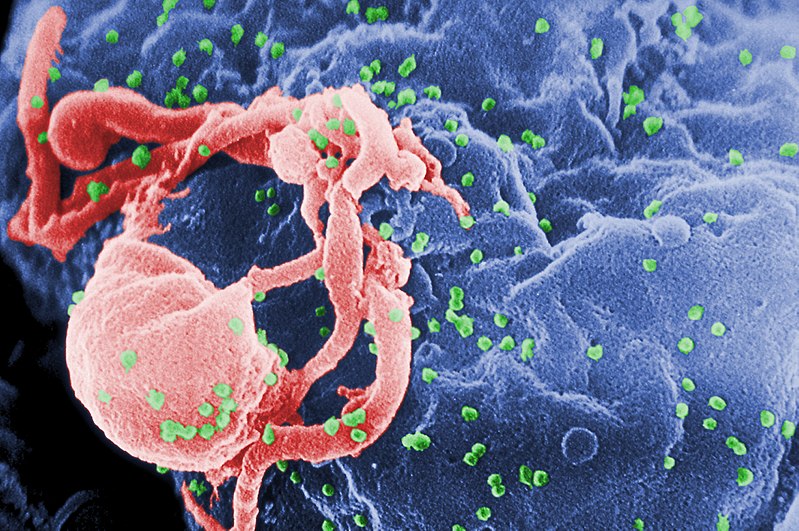
HIV-1 budding from a host cell.
Additional Discoveries
I'm sure you realize that scientific discoveries are published every day. In 2010, the U.S. National Library of Medicine and National Institutes of Health posted over 877,000 new articles and publications on pubmed.gov, a well known database for scientific publications. These publications range to new approaches to blocking malaria transmission to new genomic sequences discovered; Vaccine trial results to epidemiological analysis of target populations.
Its amazing what scientists do every day and most people have no idea. You only hear about the huge breakthroughs, but every little bit counts and contributes towards the bigger picture.
As for the New Year, I'm going to try my hardest to update more regularly, but I've set some pretty lofty goals for myself for 2011, so I hoe you'll understand if I do slip up occasionally. Hopefully, this year, I'll be one of those 877,000 papers, and I'm also working on a chapter for a textbook. We'll see how it all pans out.
Here's to a scientific 2011, one hopefully filled with many entries on Under the Microscope!
*Note: I had nothing to do with the discovery of this microorganism. Tricked you!
Saturday, November 13, 2010
Tis the season for Parasitic Infections!
Ah, the holiday season. It seems that this time of year has become synonymous with meat-laden tables. Meat buffets. Meat, meat and more meat. Each culture seems to have their meat of choice for holiday celebrations, too. Some people won't celebrate Thanksgiving unless there is a 5800 lb turkey in the middle of the table. For some, it's ham, lamb or even fish.
Meat is also one of the most expensive food items you can buy, so for some families, the holidays are a time to splurge. Sure, it's reasonable to get the biggest cut of lamb you've ever seen to feed your family of 6. For this post, let's focus on the up-and-coming Thanksgiving turkey.
Nearly 50 million turkeys are raised and slaughtered for Thanksgiving every year in the United States. Think about the magnitude of such an endeavor.
One of the most common parasitic roundworms of poultry, Ascaridia galli, occurs in chickens and turkeys. Adult worms are about one and a half to three inches long and can be seen easily with the naked eye. Heavily infected birds may show droopiness, emaciation and diarrhea. Yet, when you have thousands of birds to take care of...would you notice one droopy bird? I wonder, how easy would it be to identify a bird with diarrhea in a factory farm setting?
Chickens of three to four months of age show resistance to infection. Specimens of this parasite are found occasionally in eggs. The worm apparently wanders from the intestine up the oviduct and is included in the egg contents as the egg in being formed.
The parasitic females lay thick heavy-shelled eggs in the intestine that pass in the feces. Embryonated eggs are very hardy and under laboratory conditions may live for two years. Under ordinary conditions, however, few probably live more than one year. Disinfectants and other cleaning agents do not kill eggs under farm conditions. Birds become infected by eating eggs that have reached the infective stage. The parasite can be controlled by strict sanitation.
I don't know about you, but the words "strict sanitation" always make me think of poultry farms.
Ascaridia can infect other species of animals as well, including humans. Affectionately called "giant intestinal roundworms", A. lumbricoides is the most common infection of roundworm in humans. The intestinal phase causes malnourishment, intestinal blockage, verminous intoxication. It will also move around in the body in response to chemotherapy or fever. A worm with climate sensitivity, how posh!
They can also live in your lungs, which I would imagine would be... fun. In the lung it causes hemorrhage, inflammation, bacterial infection and allergy in areas with seasonal transmission. I can only imagine having seasonal transmission being a common thing in your area. "Hey boss, I can't come into work today because I've got that pesky lungworm thing that's going around now. I'm sure I'll feel better tomorrow."
Heterakis gallinae is found in the ceca of chickens, turkeys and other birds. This parasite apparently does not seriously affect the health of the bird. At least no marked symptoms or pathology can be blamed on its presence. Its main importance is that it has been incriminated as a vector of Histomonas meleagridis, the agent that causes blackhead. This protozoan parasite apparently is carried in the cecal worm egg and is transmitted from bird to bird through this egg. The eggs of the parasite are very resistant to environmental conditions and will remain viable for long periods.
There are several species of Capillaria that occur in poultry. Capillaria annulata and Capillaria contorta occur in the crop and esophagus. These may cause thickening and inflammation of the mucosa.
Capillaria obsignata is the most prevalent in the lower intestinal tract. The life cycle of this parasite is direct: The adult worms may be embedded in the lining of the intestine. The eggs are laid and passed in the droppings. The eggs are infective to any other poultry that may eat them. The parasites frequently produce severe inflammation and sometimes cause hemorrhage. Brutal erosion of the intestinal lining may result in death. If present in large numbers, these parasites are usually easy to find at necropsy.
Capillaria are pretty easy to spread to humans, especially in the farm environment. Once again, sanitation is the key factor...
Tapeworms or cestodes are flattened, ribbon-shaped worms composed of numerous segments or division. The head or anterior end is much smaller than the rest of the body to assist with anchoring.
All poultry tapeworms spend part of their lives in intermediate hosts, and birds become infected by eating the intermediate hosts. These hosts include snails, slugs, beetles, ants, grasshoppers, earthworms, houseflies and others. The intermediate host becomes infected by eating the eggs of tapeworms that are passed in the bird feces.
Tapeworms can definitely infect humans. Some people live for years without knowing that they have a giant worm housed in their intestines, whereas others have an allergic reaction within about a week. Most infections are specific to mammals or poultry. It is more common to get a tapeworm infection from consuming or working around cows, sheep, pigs or dogs than it is from poultry, but a lot of family farms contain multiple types of animals in one small area. Think about it.
For mammalian-infecting tapeworms, the scolex (or "head") of the worm is adorned with a series of hooks and suckers to effectively anchor itself into the intestinal wall. Poultry tapeworms work in a similar fashion, but have a different scolex shape and pattern.
The gapeworm is a round red worm that attach to the trachea (windpipe) of birds and causes the disease referred to as "gapes". The term describes the open-mouth breathing characteristic of gapeworm-infected birds. Heavily infected birds usually emit a grunting sound because of the difficulty in breathing and many die from suffocation. The life cycle of the gapeworm is similar to that of the cecal worm. Gapeworms infect chickens, turkeys, guinea fowl, pheasants, chukar partridge, and other birds.
The worms can easily block the trachea, so they are particularly harmful to young birds. The gapeworm is sometimes designated as the "red-worm"; or "forked-worm" because of its red color and because the male and female are joined in permanent copulation. They appear like the letter Y. The female is the larger of the two, as is pretty normal for a lot of insecta and helminth species. Both sexes attach to the lining of the trachea with their mouthparts. Sufficient numbers may accumulate in the trachea to hinder air passage. Choked to death by a worm orgy...
So, let's recap:
Meat is also one of the most expensive food items you can buy, so for some families, the holidays are a time to splurge. Sure, it's reasonable to get the biggest cut of lamb you've ever seen to feed your family of 6. For this post, let's focus on the up-and-coming Thanksgiving turkey.
Nearly 50 million turkeys are raised and slaughtered for Thanksgiving every year in the United States. Think about the magnitude of such an endeavor.
Depending on the size, socioeconomic status and number of workers employed, the average turkey farm can house 7,000 turkeys at once. It takes a ridiculous amount of farms to produce enough turkeys for slaughter in time for Thanksgiving!
Why am I telling you this? I know, this sounds like advocacy for animals (I could write for daaaaays about animal cruelty, trust me), but this is strictly a science blog, so I'm telling you this as a back story. Statistical purposes.
Once again, think of the magnitude of such an operation. Now, here is the important part: try to imagine the odds for contamination in such a magnitude. Who's to say you didn't buy the turkey carcass that was accidentally dropped on the kill-room floor, and quickly swooped up before anyone else would notice? Who's to say the person plucking the feathers out of your turkey had a hole in their glove and didn't wash their hands thoroughly enough before coming to work or after using the restroom? Who's to say accuracy isn't as accurate as efficiency to the slaughterhouse that your turkey is coming from? Who's to say that every bird has been checked for health? Is the farm your turkey is from relying on mass quantities of antibiotics and treatments to keep them safe?
When you finally get your bird home, how sure are you about the quality? What quality? No, I'm not talking about the tenderness of the flesh or the overall freshness. No, I'm not talking about the growth hormone-induced size of the thighs, wings and breast.
We've all heard about Escherichia coli and other fun bacterial contamination agents that rampantly infect our food, but let's talk about some other of the fun things that could be living on, and in, your prized dinner selection:
Poultry:
Poultry are susceptible to many parasitic infections, internally and externally.
External parasites, such as lice and mites, spread quickly in impacted battery farms, yet most of them are removed during the plucking and washing processes of slaughter. External parasites are more of an issue if you are raising, slaughtering and preparing your own birds in-house.
Internal Parasites:
Ascarids (Large Intestinal Roundworms)
One of the most common parasitic roundworms of poultry, Ascaridia galli, occurs in chickens and turkeys. Adult worms are about one and a half to three inches long and can be seen easily with the naked eye. Heavily infected birds may show droopiness, emaciation and diarrhea. Yet, when you have thousands of birds to take care of...would you notice one droopy bird? I wonder, how easy would it be to identify a bird with diarrhea in a factory farm setting?
Chickens of three to four months of age show resistance to infection. Specimens of this parasite are found occasionally in eggs. The worm apparently wanders from the intestine up the oviduct and is included in the egg contents as the egg in being formed.
The parasitic females lay thick heavy-shelled eggs in the intestine that pass in the feces. Embryonated eggs are very hardy and under laboratory conditions may live for two years. Under ordinary conditions, however, few probably live more than one year. Disinfectants and other cleaning agents do not kill eggs under farm conditions. Birds become infected by eating eggs that have reached the infective stage. The parasite can be controlled by strict sanitation.
I don't know about you, but the words "strict sanitation" always make me think of poultry farms.
Ascaridia can infect other species of animals as well, including humans. Affectionately called "giant intestinal roundworms", A. lumbricoides is the most common infection of roundworm in humans. The intestinal phase causes malnourishment, intestinal blockage, verminous intoxication. It will also move around in the body in response to chemotherapy or fever. A worm with climate sensitivity, how posh!
They can also live in your lungs, which I would imagine would be... fun. In the lung it causes hemorrhage, inflammation, bacterial infection and allergy in areas with seasonal transmission. I can only imagine having seasonal transmission being a common thing in your area. "Hey boss, I can't come into work today because I've got that pesky lungworm thing that's going around now. I'm sure I'll feel better tomorrow."
I feel like this photo should be submitted to awkwardfamilyphotos.com.
Capillaria obsignata is the most prevalent in the lower intestinal tract. The life cycle of this parasite is direct: The adult worms may be embedded in the lining of the intestine. The eggs are laid and passed in the droppings. The eggs are infective to any other poultry that may eat them. The parasites frequently produce severe inflammation and sometimes cause hemorrhage. Brutal erosion of the intestinal lining may result in death. If present in large numbers, these parasites are usually easy to find at necropsy.
Capillaria are pretty easy to spread to humans, especially in the farm environment. Once again, sanitation is the key factor...
All poultry tapeworms spend part of their lives in intermediate hosts, and birds become infected by eating the intermediate hosts. These hosts include snails, slugs, beetles, ants, grasshoppers, earthworms, houseflies and others. The intermediate host becomes infected by eating the eggs of tapeworms that are passed in the bird feces.
Tapeworms can definitely infect humans. Some people live for years without knowing that they have a giant worm housed in their intestines, whereas others have an allergic reaction within about a week. Most infections are specific to mammals or poultry. It is more common to get a tapeworm infection from consuming or working around cows, sheep, pigs or dogs than it is from poultry, but a lot of family farms contain multiple types of animals in one small area. Think about it.
Yes, this is obviously a good idea.
The worms can easily block the trachea, so they are particularly harmful to young birds. The gapeworm is sometimes designated as the "red-worm"; or "forked-worm" because of its red color and because the male and female are joined in permanent copulation. They appear like the letter Y. The female is the larger of the two, as is pretty normal for a lot of insecta and helminth species. Both sexes attach to the lining of the trachea with their mouthparts. Sufficient numbers may accumulate in the trachea to hinder air passage. Choked to death by a worm orgy...
So, let's recap:
- Poultry are raised and slaughtered typically in unsanitary conditions, causing unnecessary spread of many fun infective agents, most of which can be transferred to humans.
- Since the holidays are nearing, millions of turkeys and other poultry will be slaughtered in mass quantities. Supply and demand means that time and efficiency is the highest priority for the industry.
- I'm sure many of the above photos grossed you out.
- Pay attention to the source of your dinner. Has your bird been raised "free-range" (*cough* yeah, right *cough*) or in a battery farm? Has your bird been pumped full of antibiotics, growth hormones or other dietary treatments? All of that will be transferred to your body during consumption, to some degree.
- Learn how to properly handle and prepare meat. Be prepared, its quite a bit of work.
- Learn about the origin of your family's traditional meat consumption. Is it really a tradition, or just a habit at this point? Is it really that important for you to uphold the years of excess meat consumption, or is it time for a healthier, safer change?
- Think about starting a new tradition. Sure, everything you get from a mass-produced source, like the grocery store, has a higher likelihood of having contamination of some sort, whether its meat, dairy or vegetables. But! The probability of contamination through vegetable and grain sources is much lower than that of meat preparation.
Try something new, healthy (and cruelty free) this year!
Sunday, October 24, 2010
Love in the time of Haiti
Ahh, Cholera, what an interesting history you have. Such a small bacterium can definitely grouped in with the most historically significant pathogens in the history of humans. And, although we've figured you out, you still never cease to infect us.
If you aren't hip to reading news, or science/health news specifically, then you probably aren't aware of the fact that Cholera is ripping through Haiti's rural towns and has made it to the capital. This is important, for historical reasons...and because Cholera kills 100,000 to 120,000 people every year.
Lets take a little trip through the pathogenic history of Vibrio cholerae.
1816 - 1826: The first recorded outbreak and epidemic of Cholera struck Bengal and spread through China, Indonesia and the Caspian Sea with British troops. It is estimated that 15 million people died during the ten year tour of Cholera.
1829 - 1851: Russia, Hungary, London and Paris are all affected. Scientists scrambled to figure out the method of transmission of Cholera, while mass hysteria hit the major cities. The media coined the term "King Cholera" (which is of the same caliber as calling H1N1 "Swine Flu", in my opinion).
This was a specifically crucial time in the development of Epidemiology. Many scientists were throwing out disease theories in hopes that one would stick. William Farr proposed the Miasmatic Theory of Disease, suspecting that Cholera was spread through "bad air" or "poisonous air".
Sorry, William Farr, you were wrong. But, many grim, black metal-esque illustrations were created to emphasize the false truth of this theory.
Remember, at this time in history, faith-based disease theory and healing were still alive and widely believed. If it wasn't the deadly diarrhea that scared you, then the giant Cholera spirit surely would.
I shouldn't admit that I was tempted to make an AC/DC reference as the caption for that photo...
Anyway, John Snow, a British physician, took the cake with his theory on the spread of Cholera in 1854. Snow discovered that Cholera was being spread through use of contaminated water pumps that were being sourced from a well that was only 3 feet away from a cesspit. He discovered this by going door to door and surveying the people about their symptoms, and the source of their water. People actually told him that the pump that was, unknowingly, contaminating everyone was the source of the best water in town.
...maybe it was the added benefit of a gram negative bacterium.
Following the UK and Europe's Cholera outbreak, the bacterium spread throughout Asia, Africa and South America. There have been outbreaks in North America, but nowhere as severe and widespread as those in Africa and South America.
So this brings us back to Haiti. Ten months ago, Haiti endured a 7.0 magnitude earthquake that left 1,000,000 people homeless. Most of these people have used any resources available to create a "tent cities" (Haitian hooverville?) throughout Haiti, yet mostly centered near Port-au-Prince. Earthquakes, obviously, affect sewage and sanitation, so it was really only a matter of time before we heard about an outbreak of Giardiasis or Cholera. On top of that, 230,000 people died during the earthquake and subsequent aftershocks. Now, Haitians must live amongst ruined sanitation efforts and mass graves.
Over 200 people have died from Cholera in Haiti in this latest outbreak. Cholera can kill its victims pretty quickly if not treated adequately. There is typically a period of 2-15 days between infection and symptoms. Most people that are infected with Vibrio cholerae experience terrible fits of diarrhea, fever, sometimes vomiting, and extreme dehydration.
Approximately 80% of illnesses in developing countries can be attributed to their poor sanitation and lack of adequate water sources. There are non-profit organizations that are working to address this issue. Many organizations have attempted to give aid and develop programs to bring clean, safe water to communities in need, but have failed to realize that they need to focus on the sustainability of the project, as well. How feasible is it for these communities to maintain the project after relief and aid efforts have left the area? Where is the money going, exactly? What are the needs for upkeep and use of the project?
If you are thinking about donating to an organization that addresses water issues, make sure you read up on the sustainability of their program. The Water Project has emphasized the sustainability of their program, and it seems like a reasonable effort. You can check out their completed projects here.
Thursday, September 9, 2010
Let's be honest...
Yes, let's. I didn't really want to have to touch on this issue, because I didn't want to risk putting my personal views on "hot topics" out there. That's not the purpose of this blog. Yet, I did decide that it might be helpful if I made a guide to some things that are being thrown around and actively banned.
Really, without understanding the basics, I think its hard to form an opinion. Most news stories don't dabble into the real science of it, so where else are you going to get this information?
So, let's jump right into it.
What are Embryonic Stem Cells, anyway?
Embryonic Stem Cells (also called "Early Stem Cells" or ESCs) are totipotent stem cells, meaning they have the ability to develop into just about any type of cell in our bodies. See, each cell needs to be specific to what its working to do. Nerve cells need to be specific to sending and receiving signals, heart cells need to be specific to beating (and skipping beats, if you're feeling fancy), and so on. It's kind of like how people go to school to become specialized for their careers. You wouldn't want a gourmet chef working on your car, a veterinarian building your house, or a vegan cooking you a honey-baked ham, right? I guess that's...a silly analogy, but stick with me.
These totipotent cells come specifically from the fusion of germ cells which, if allowed to develop in the right conditions, will turn into an embryo and eventually go through the basic cycles of human development. You can see this occurring in the following video from HHMI:
In the video, at around time 00:50, you can see a very important structure being formed: The Blastocyst. I'm sure you've heard of the cell multiplying over and over again, but at this point, the cells divide into two very important classifications: the "structural" cells that assist the embryo in developing, and the Inner Cell Mass (ICM). The outer cells that form the structural components create things like the placenta, and assist with attachment to the endometrium that lines the inner most layers of the uterus. These outer cells form the hollow ball structure of the blastocyst, as seen below.
As you can see, these blastocysts are pretty tiny... no where near the size of a full fetus yet.
The ICM actively develops into the mammal, if conditions are appropriate. The cells that make up the ICM are totipotent as the blastocyst is developing and implanting. These are the cells that are harvested for Stem Cell Research.
I've heard people say that stem cells come from abortions. I've heard people say that doctors are stealing the unused, frozen embryos or egg cells from In Vitro Fertilization (IVF) procedures and storage for research. I've heard people say that stem cells used for to research medical treatment for serious diseases will eventually create mutant humans.
None of those people were doctors, scientists, or...educated in human development whatsoever.
Actually, what happens is this:
Everyone involved (ie- the people the cells are harvested from) are informed completely and given the option to have their germ cells used for research purposes. This usually happens if a couple opts for IVF treatments if they cannot get pregnant through "natural causes", or if they are trying to obtain pregnancy through a surrogate party. In this case, they never just fertilize and store (deep freeze) just one. IVF is a very tricky procedure that can take many, many tries for an actual success.
Now, there are actually other ways to harvest stem cells for treatments, but the cells will not be totipotent. Pluripotent and multipotent cells have more specificity due to the advancement of their differentiation within the body. An example of pluripotent stem cells would be those from an organ system: they are more specific in overall function than totipotent stem cells, but still have the ability to further differentiate to a more specific cell type/function within the organ system.To harvest pluripotent and multipotent stem cells, blastocystic cells do not have to be used. In some instances, they can be harvested from adults and even from the patient themselves (depending on the treatment method and type of cells harvested). In fact, some procedures are being done to harvest mesenchymal stem cells from human teeth!
The Uses:
The possibilities are endless for stem cell research and treatment. Some of the diseases or medical problems that are actively being researched for treatments with stem cells are: Brain damage, cancer, spinal cord injury, heart damage, mutated blood cell formation, baldness, some forms of deafness, blindness and other gradients of vision impairment, amyotrophic lateral sclerosis (ALS), Crohn's disease, Parkinson's disease, Alzheimer's and dementia, birth defects, diabetes, immunodeficiencies and wound healing problems, infertility, paralysis, organ and tissue damage, and on and on!
Some treatments are currently being used in veterinary practices with very enthusiastically positive results. These dogs happily wag their tails in support of stem cell treatment:
The Ban:
You may or may not have been following the recent flip-flopping in the judicial system regarding stem cell research funding last month, but as of today, the court temporarily lifted the ban that was put in place about a week ago. The government has a very large part in scientific research, through the National Institute of Health (NIH) funding grants and special interest funds. Especially regarding stem cells, the funding for embryonic cell use in research for medical advancement and treatments is very financially fragile, and unfortunately, expensive. Luckily, the stay was motioned today, but the fight is not over. This is an issue that comes up in every election, every political campaign, and every clash between the left and right.
To read more on the stay that was motioned today, TIME has posted a very thorough article on their website, here.
Since this is a very important topic, I suggest you keep up to date through NIH Court Order updates on their website: http://stemcells.nih.gov/.
For anything that is ethically debated between conservative, religious groups and scientific believers, I urge you to educate yourself. Learn both arguments, and form your own opinions.
...but don't forget that science is always right.
Embryonic Stem Cells
Do you really understand what happens? How they are used? Where they come from?Really, without understanding the basics, I think its hard to form an opinion. Most news stories don't dabble into the real science of it, so where else are you going to get this information?
So, let's jump right into it.
What are Embryonic Stem Cells, anyway?
Embryonic Stem Cells (also called "Early Stem Cells" or ESCs) are totipotent stem cells, meaning they have the ability to develop into just about any type of cell in our bodies. See, each cell needs to be specific to what its working to do. Nerve cells need to be specific to sending and receiving signals, heart cells need to be specific to beating (and skipping beats, if you're feeling fancy), and so on. It's kind of like how people go to school to become specialized for their careers. You wouldn't want a gourmet chef working on your car, a veterinarian building your house, or a vegan cooking you a honey-baked ham, right? I guess that's...a silly analogy, but stick with me.
These totipotent cells come specifically from the fusion of germ cells which, if allowed to develop in the right conditions, will turn into an embryo and eventually go through the basic cycles of human development. You can see this occurring in the following video from HHMI:
In the video, at around time 00:50, you can see a very important structure being formed: The Blastocyst. I'm sure you've heard of the cell multiplying over and over again, but at this point, the cells divide into two very important classifications: the "structural" cells that assist the embryo in developing, and the Inner Cell Mass (ICM). The outer cells that form the structural components create things like the placenta, and assist with attachment to the endometrium that lines the inner most layers of the uterus. These outer cells form the hollow ball structure of the blastocyst, as seen below.
As you can see, these blastocysts are pretty tiny... no where near the size of a full fetus yet.
The ICM actively develops into the mammal, if conditions are appropriate. The cells that make up the ICM are totipotent as the blastocyst is developing and implanting. These are the cells that are harvested for Stem Cell Research.
I've heard people say that stem cells come from abortions. I've heard people say that doctors are stealing the unused, frozen embryos or egg cells from In Vitro Fertilization (IVF) procedures and storage for research. I've heard people say that stem cells used for to research medical treatment for serious diseases will eventually create mutant humans.
None of those people were doctors, scientists, or...educated in human development whatsoever.
Actually, what happens is this:
Everyone involved (ie- the people the cells are harvested from) are informed completely and given the option to have their germ cells used for research purposes. This usually happens if a couple opts for IVF treatments if they cannot get pregnant through "natural causes", or if they are trying to obtain pregnancy through a surrogate party. In this case, they never just fertilize and store (deep freeze) just one. IVF is a very tricky procedure that can take many, many tries for an actual success.
Now, there are actually other ways to harvest stem cells for treatments, but the cells will not be totipotent. Pluripotent and multipotent cells have more specificity due to the advancement of their differentiation within the body. An example of pluripotent stem cells would be those from an organ system: they are more specific in overall function than totipotent stem cells, but still have the ability to further differentiate to a more specific cell type/function within the organ system.To harvest pluripotent and multipotent stem cells, blastocystic cells do not have to be used. In some instances, they can be harvested from adults and even from the patient themselves (depending on the treatment method and type of cells harvested). In fact, some procedures are being done to harvest mesenchymal stem cells from human teeth!
The Uses:
The possibilities are endless for stem cell research and treatment. Some of the diseases or medical problems that are actively being researched for treatments with stem cells are: Brain damage, cancer, spinal cord injury, heart damage, mutated blood cell formation, baldness, some forms of deafness, blindness and other gradients of vision impairment, amyotrophic lateral sclerosis (ALS), Crohn's disease, Parkinson's disease, Alzheimer's and dementia, birth defects, diabetes, immunodeficiencies and wound healing problems, infertility, paralysis, organ and tissue damage, and on and on!
Some treatments are currently being used in veterinary practices with very enthusiastically positive results. These dogs happily wag their tails in support of stem cell treatment:
The Ban:
You may or may not have been following the recent flip-flopping in the judicial system regarding stem cell research funding last month, but as of today, the court temporarily lifted the ban that was put in place about a week ago. The government has a very large part in scientific research, through the National Institute of Health (NIH) funding grants and special interest funds. Especially regarding stem cells, the funding for embryonic cell use in research for medical advancement and treatments is very financially fragile, and unfortunately, expensive. Luckily, the stay was motioned today, but the fight is not over. This is an issue that comes up in every election, every political campaign, and every clash between the left and right.
To read more on the stay that was motioned today, TIME has posted a very thorough article on their website, here.
Since this is a very important topic, I suggest you keep up to date through NIH Court Order updates on their website: http://stemcells.nih.gov/.
For anything that is ethically debated between conservative, religious groups and scientific believers, I urge you to educate yourself. Learn both arguments, and form your own opinions.
...but don't forget that science is always right.
Subscribe to:
Posts (Atom)